Osteoarthritis
How a joint works, why it hurts, what helps without surgery and when it is time to discuss an operation
Author: Bagrat DzhavakhyanTreatment navigator, portal author
Not yet reviewed by a physicianSources: Russian Ministry of Health guidelines 2024, NHS, AAOS[1, 2, 4, 5]1Клинические рекомендации «Коксартроз» (ID 870_1) — Минздрав России, 20242Клинические рекомендации «Гонартроз» — Минздрав России, 20244Total Knee Replacement — AAOS OrthoInfo, 20245Knee replacement — NHS, 2024To the list of sources →
Your route: Back to your route

In brief
- Surgery is discussed at stage III osteoarthritis if treatment without surgery has not helped.
- Treatment starts with exercise therapy, weight loss and painkillers.
- The operation takes 1–2 hours; you stand up with support on the first day.
- In Russia it can be free under OMS or a VMP quota; the wait depends on the region.
1Understand
Joint replacement and osteoarthritis
Joint replacement swaps the worn surfaces of a joint for artificial ones. Doctors call the artificial joint an endoprosthesis; on this site we say implant. It is most often used for severe osteoarthritis of the knee and hip.
Osteoarthritis is the gradual breakdown of cartilage. Doctors also call it arthrosis. Cartilage covers the ends of the bones and lets them glide without friction. When it wears away, bone rubs on bone. The joint hurts, swells and loses movement.
Not everyone with a painful knee or hip needs surgery. It is discussed when pain seriously limits your life and treatment without surgery no longer helps[1, 2]1Клинические рекомендации «Коксартроз» (ID 870_1) — Минздрав России, 20242Клинические рекомендации «Гонартроз» — Минздрав России, 2024To the list of sources →. In 2019 Russia performed 147,061 primary joint replacements. Of these, 83,311 were hips and 63,750 were knees[3]3Эпидемиология эндопротезирования тазобедренного и коленного суставов и перипротезной инфекции в Российской Федерации — Травматология и ортопедия России, 27(3):84–93, 2021To the list of sources →.
Unfamiliar words are explained in the patient glossary.
How a joint is built
The knee and hip carry more load than any other joints. The hip is a ball in a socket: the head of the thigh bone turns in a cup in the pelvis. The knee is a hinge of the thigh bone, shin bone and kneecap. The bone ends are covered with cartilage. A capsule filled with fluid surrounds the joint and nourishes the cartilage.
Cartilage has no blood supply and barely repairs itself. As it wears, the bone beneath it hardens. Bony spurs called osteophytes grow at the edges. The joint space narrows, the joint lining becomes inflamed and movement starts to hurt.
Main causes of joint damage[1, 2]1Клинические рекомендации «Коксартроз» (ID 870_1) — Минздрав России, 20242Клинические рекомендации «Гонартроз» — Минздрав России, 2024To the list of sources →:
- Primary osteoarthritis: cartilage wears with age.
- Excess weight adds load on the knee and hip with every step.
- Injuries: fractures, ligament and meniscus tears. Osteoarthritis can start years later.
- Dysplasia: a hip socket that did not form properly at birth, so the load is spread unevenly.
- Avascular necrosis: part of the head of the thigh bone dies when its blood supply is cut off.
- Rheumatoid arthritis and other inflammatory diseases that destroy cartilage.
What happens to the joint
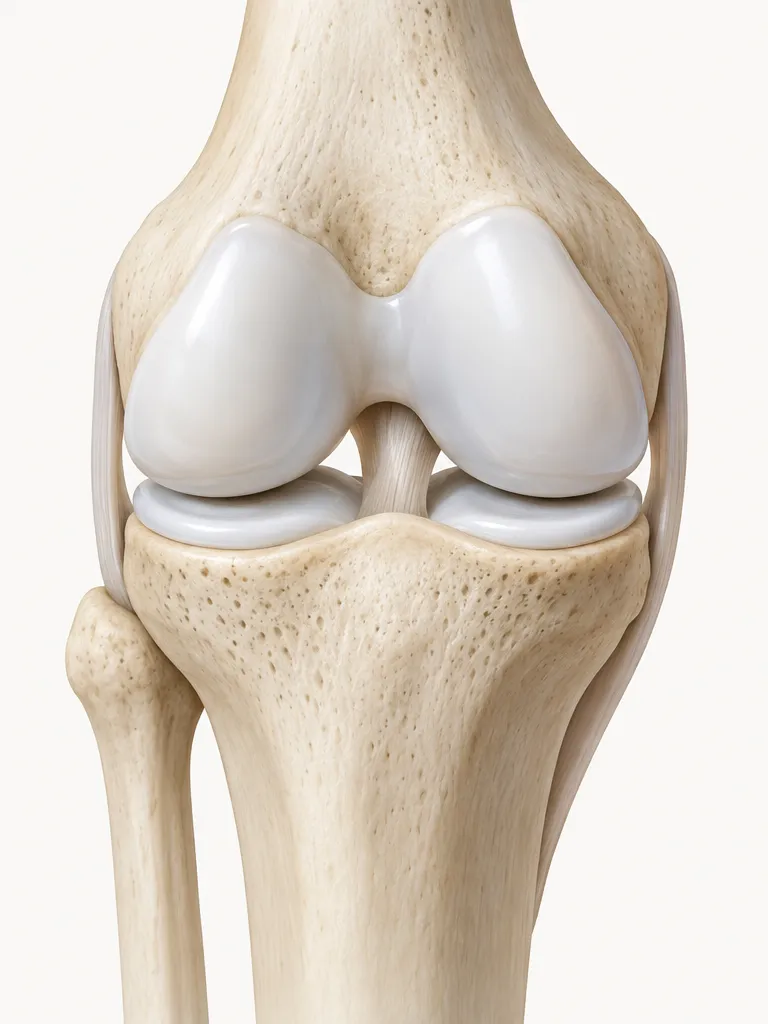
Healthy cartilage, even joint space
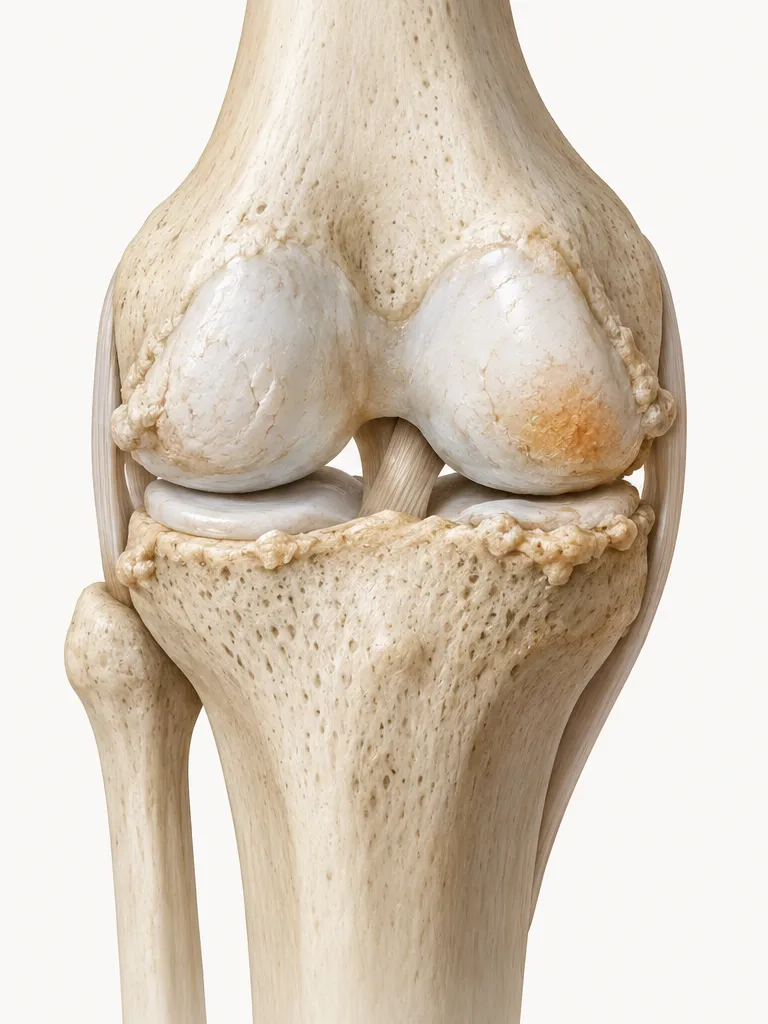
Thinner cartilage, narrowed joint space
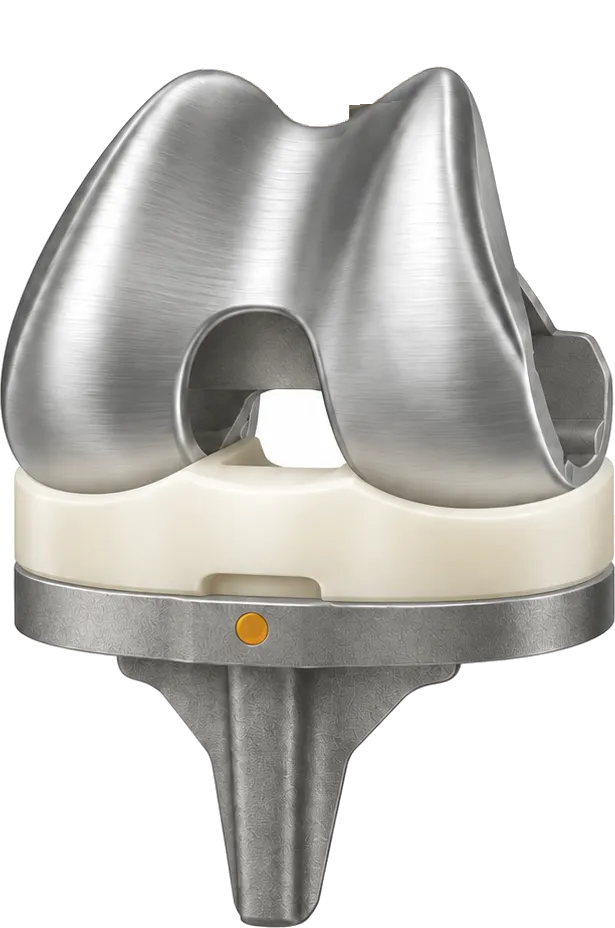
An implant replaces the damaged joint surfacesSchematic implant, different view
Stages of osteoarthritis
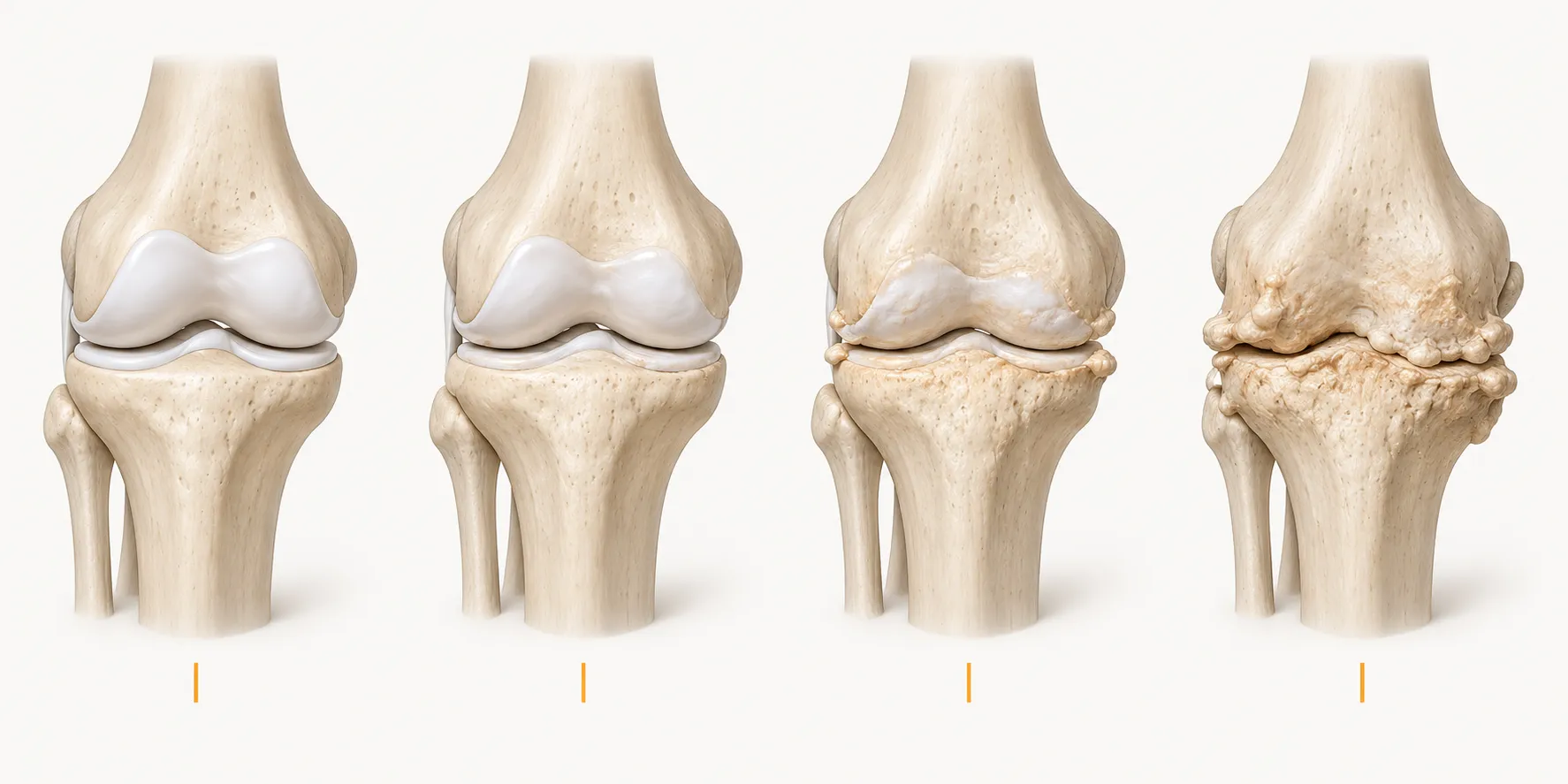
The stage is graded from an X-ray. Russia uses two scales: Kosinskaya (three stages) and Kellgren–Lawrence (grades 0 to IV)[1]1Клинические рекомендации «Коксартроз» (ID 870_1) — Минздрав России, 2024To the list of sources →. The stage decides whether you are offered treatment without surgery or joint replacement.
Surgery is usually discussed at Kosinskaya stage III (Kellgren–Lawrence III–IV) if treatment without surgery has not helped[1]1Клинические рекомендации «Коксартроз» (ID 870_1) — Минздрав России, 2024To the list of sources →. At stages I–II the joint is usually treated without surgery.
Grading scales
2 min
| Stage: Kosinskaya / Kellgren–Lawrence | What the X-ray shows | What you feel |
|---|---|---|
| — / 0 | No changes | Usually no complaints |
| I / I–II | Joint space slightly narrowed, a few osteophytes | Pain after activity that eases with rest |
| II / III | Joint space narrowed 2–3 times, many osteophytes, hardened bone | Pain when walking and at rest, limping, stiffness, grinding |
| III / IV | Joint space almost gone, bones deformed, cysts | Constant pain, severely limited movement, a shortened leg |
The stages follow the Ministry of Health guidelines[1, 2]1Клинические рекомендации «Коксартроз» (ID 870_1) — Минздрав России, 20242Клинические рекомендации «Гонартроз» — Минздрав России, 2024To the list of sources →. The scales do not match exactly, so the correspondence is approximate.
Symptoms
Osteoarthritis develops over years, and the first signs are easy to put down to tiredness. See an orthopaedic surgeon if you notice[2]2Клинические рекомендации «Гонартроз» — Минздрав России, 2024To the list of sources →:
- Start-up pain: the first steps after sleep or long sitting hurt, then ease.
- Morning stiffness that clears within half an hour.
- Pain on load: on stairs, getting up from a chair, after a long walk.
- Grinding and clicking in the joint when it moves.
- Limited movement: putting on socks, tying shoelaces or sitting on a low chair is hard.
- A limp and a feeling that the leg is shorter. This happens when the hip is affected.
- Night pain that disturbs sleep. A doctor should assess it: it occurs in osteoarthritis and in other conditions.
None of these alone means you need surgery. It is a reason to see a doctor and discuss whether you need an X-ray.
Diagnosis
A doctor makes the diagnosis at an appointment. Three steps are usually enough[1, 2]1Клинические рекомендации «Коксартроз» (ID 870_1) — Минздрав России, 20242Клинические рекомендации «Гонартроз» — Минздрав России, 2024To the list of sources →:
- Examination. The doctor checks your gait, range of movement, leg length, muscle strength and tenderness.
- X-ray in two views, standing, with weight on the leg. The stage is graded from it.
- Questionnaires such as WOMAC or the Oxford Hip/Knee Score. They ask about pain and daily activities. They show how much the disease limits you and let you compare before and after treatment.
Diagnosis in detail
1 min
MRI (magnetic resonance imaging) is not always needed. It is ordered if a meniscus or ligament injury or early avascular necrosis is suspected. CT (computed tomography) is used before complex operations and to plan some robotic operations.
Before surgery you also have blood and urine tests, an ECG, and a GP and dental check. They rule out hidden infection[4]4Total Knee Replacement — AAOS OrthoInfo, 2024To the list of sources →.
2Decide
Treatment without surgery
Under the 2024 Ministry of Health guidelines, treatment starts without surgery[1, 2]1Клинические рекомендации «Коксартроз» (ID 870_1) — Минздрав России, 20242Клинические рекомендации «Гонартроз» — Минздрав России, 2024To the list of sources →. For many people this is enough for years. Its goal is less pain and better movement. There is no proof that it slows osteoarthritis down[13]13Osteoarthritis in over 16s: diagnosis and management (NG226) — NICE, 2022To the list of sources →.
A plan usually includes:
- Exercise therapy: the main method. Exercise 2–3 times a week strengthens the muscles around the joint and reduces pain. The effect appears within a few weeks and lasts as long as you keep going[2]2Клинические рекомендации «Гонартроз» — Минздрав России, 2024To the list of sources →.
- Weight loss. The target is a body mass index below 25[1]1Клинические рекомендации «Коксартроз» (ID 870_1) — Минздрав России, 2024To the list of sources →. Even moderate weight loss reduces knee and hip pain.
- Painkillers. Non-steroidal anti-inflammatory drugs (NSAIDs) such as ibuprofen or naproxen relieve pain and inflammation. They can harm the stomach, heart and kidneys. So a doctor sets the dose and how long you take them[1]1Клинические рекомендации «Коксартроз» (ID 870_1) — Минздрав России, 2024To the list of sources →.
Medicines, injections, braces
2 min
- Chondroprotectors (chondroitin, glucosamine). Russian guidelines allow long-term use[1]1Клинические рекомендации «Коксартроз» (ID 870_1) — Минздрав России, 2024To the list of sources →. Views on how well they work differ, and guidelines vary between countries[13]13Osteoarthritis in over 16s: diagnosis and management (NG226) — NICE, 2022To the list of sources →.
- Hyaluronic acid injections. Some patients report less pain for a few months. Guidelines differ: NICE, for example, does not recommend hyaluronan[13]13Osteoarthritis in over 16s: diagnosis and management (NG226) — NICE, 2022To the list of sources →.
- Steroid injections are given only for inflammation and no more than once every three months. Frequent injections harm cartilage[1]1Клинические рекомендации «Коксартроз» (ID 870_1) — Минздрав России, 2024To the list of sources →.
- A cane, braces, comfortable shoes. A cane held on the side of the healthy leg takes some load off the joint.
- Physiotherapy helps at early stages. It adds to exercise therapy and does not replace it[1]1Клинические рекомендации «Коксартроз» (ID 870_1) — Минздрав России, 2024To the list of sources →.
What not to do: put up with pain untreated, change NSAID doses yourself, or have courses of injections without a reason. Treatment without surgery does not rebuild cartilage[13]13Osteoarthritis in over 16s: diagnosis and management (NG226) — NICE, 2022To the list of sources →.
Indications for surgery
There is no set age or moment for surgery. You and your surgeon weigh pain, limitations and risks together[1, 4]1Клинические рекомендации «Коксартроз» (ID 870_1) — Минздрав России, 20244Total Knee Replacement — AAOS OrthoInfo, 2024To the list of sources →. There are no strict age or weight limits either[4]4Total Knee Replacement — AAOS OrthoInfo, 2024To the list of sources →. Age and weight do affect the risks and the choice of implant.
For the appointment: ticked statements
Statements are based on clinical guidelines and patient information[13, 4, 1, 2, 12]13Osteoarthritis in over 16s: diagnosis and management (NG226) — NICE, 20224Total Knee Replacement — AAOS OrthoInfo, 20241Клинические рекомендации «Коксартроз» (ID 870_1) — Минздрав России, 20242Клинические рекомендации «Гонартроз» — Минздрав России, 202412ACR/AAHKS guideline for the optimal timing of elective hip or knee arthroplasty — American College of Rheumatology / AAHKS, 2023To the list of sources →
What this means
Tick what applies to you
0 of 7 ticked
This is not a diagnosis — a guide for talking to your doctor
How long to try treatment without surgery is your doctor’s call. There is no need to repeat a course that did not help[12]12ACR/AAHKS guideline for the optimal timing of elective hip or knee arthroplasty — American College of Rheumatology / AAHKS, 2023To the list of sources →.
Surgery is usually not rushed if:
- the X-ray shows stage I–II and you have not yet tried exercise and weight loss;
- pain is moderate and well controlled;
- you have an active infection, including tooth decay or unhealed wounds;
- you have severe heart or lung disease that is not under control;
- you smoke: smoking impairs healing, so the surgeon will probably ask you to stop first.
Before seeing the surgeon, get a recent X-ray and a list of your medicines. Ask yourself what exactly you can no longer do because of the joint.
Types of operation
There are four types of operation. The table below shows when each is used.
Total replacement is the most common and best-studied option[4]4Total Knee Replacement — AAOS OrthoInfo, 2024To the list of sources →. Partial knee implants last less well: at 25 years about 70 % are still working, against 82 % of total ones[6]6How long does a knee replacement last? A systematic review and meta-analysis of case series and national registry reports with more than 15 years of follow-up — The Lancet, 393(10172):655–663, 2019To the list of sources →. Partial hip replacement is used mainly for hip fractures in older people. Revision, a repeat operation, is longer and more complex than the first, and the infection risk is higher[7]7Periprosthetic joint infection after 1.66 million primary and revision arthroplasties (2015–2023) — PMC, 2025To the list of sources →.
A robot helps place the implant more precisely. In the RACER-Knee trial patients felt no difference from standard surgery at 12 months. The robotic operation cost more[8]8Robotic-arm assisted versus conventional total knee replacement (RACER-Knee): a randomised controlled trial — The Lancet, 2026To the list of sources →. What is proven about robots is covered on the robotic joint replacement page.
| Procedure | When it is used | What is replaced | Notes |
|---|---|---|---|
| Total | Osteoarthritis of the whole joint — the most common case | All joint surfaces | The best-studied operation. At 15 years over 90% of knee implants and about 89% of hip implants are still in place (Australian and Finnish registries) |
| Partial (unicompartmental knee) | Only one knee compartment is worn, ligaments intact | One half of the knee joint | Faster recovery but more revisions than after a total |
| Revision | Wear, loosening or infection of the first implant | Part or all of the previous implant | More complex and longer, higher complication risk |
| Robotic-assisted | Any of the above, at the surgeon’s and clinic’s choice | The same as in a conventional operation | More precise component placement; no proven patient-level benefit in trials |
Sources: AAOS OrthoInfo, 2024; AAOS OrthoInfo, 2024; The Lancet, 393(10172):655–663, 2019; The Lancet, 393(10172):647–654, 2019; The Lancet, 2014; The Lancet, 2026
Questions about this chapter
Do both joints need replacing at once?
There are two approaches: both joints in one operation, or two operations a few months apart. One operation shortens the total recovery time but puts more strain on the body. The choice depends on your age, heart and lungs, and you make it together with the surgeon and the anaesthetist.
3The road
The road from first symptoms to full recovery takes months or years. Timings are approximate: they depend on the joint, the clinic and your health.
The patient journey: nine stages
Tap a stage to see details
Symptomsmonths to years
Pain on loading and when you start moving, morning stiffness under half an hour, grinding, a limp. The joint tires sooner than it used to.
What matters at this stage
- Pain that disturbs sleep or limits walking to 15–20 minutes means it is time to see an orthopaedic surgeon
- Keep a pain diary — it helps the doctor
Diagnosis1–2 visits
Examination, standing X-rays in two views, MRI only when needed. The surgeon grades osteoarthritis with the Kellgren–Lawrence (or Kosinskaya) scale.
What matters at this stage
- Standing X-rays are the basis of the diagnosis
- Pain and function scores (WOMAC, Oxford Score) record your starting point
Non-surgical treatmentindividual
Exercise therapy, weight loss, courses of pain relief, injections when indicated, braces and a cane. Surgery is discussed when these have stopped helping. How long to treat without surgery is the doctor’s call. A course that did not help need not be repeated.
What matters at this stage
- Exercise 2–3 times a week is the best-proven measure
- Every extra 5 kg adds load to the knee
Deciding on surgery1–2 consultations
The indication is stage III (Kellgren–Lawrence III–IV) osteoarthritis with pain that treatment no longer controls. You discuss expectations, risks, implant type and the route: state-funded or paid.
What matters at this stage
- Age and weight alone do not rule surgery out
- Bring a list of questions for the surgeon
Preparation
Blood tests, ECG, dental check, medication adjustments, pre-operative strengthening, home preparation: grab rails, a high chair, rugs removed, crutches bought.
What matters at this stage
- Smoking and high blood sugar raise infection risk — there is time to act
- On the state-funded route this is when the quota is issued
Surgery1–2 hours
Usually under spinal anaesthesia, sometimes general. The surgeon removes the worn surfaces and fits the implant components. A robotic system adds about 10 min.
What matters at this stage
- The antibiotic is given before the incision. Clot-prevention medicines start within the first day on the surgeon’s schedule and continue for several weeks
- Total time in theatre is longer than the operation itself
Hospital stay1–3 days abroad · 4–10 days in Russia
You stand and walk with a walker on the day of surgery or the next. Stairs on day 3–5. Clot prevention, a check X-ray before discharge.
What matters at this stage
- Pain is controlled with a combination of medicines — do not tough it out
- You leave with an exercise plan and a follow-up date
Rehabilitationweeks 1–12
Stitches come out at 10–14 days. From crutches to a cane over 2–6 weeks. Desk work usually at 6–12 weeks, working from home sometimes earlier; physical work at about 3 months.
What matters at this stage
- Driving — not before 6 weeks
- Swimming — once the wound has fully healed
Long termyears
Check X-rays at 3 and 12 months, then every 5 years. Walking, swimming, cycling, classic skiing — yes; running and jumping — not recommended.
What matters at this stage
- Tell your dentist and other doctors about the implant
- about 82% of knee and about 58% of hip implants last 25 years in registry data
Timings and figures follow the Ministry of Health guidelines, OrthoInfo, the NHS and arthroplasty registries[1, 4, 5, 9, 6, 10]1Клинические рекомендации «Коксартроз» (ID 870_1) — Минздрав России, 20244Total Knee Replacement — AAOS OrthoInfo, 20245Knee replacement — NHS, 20249Hip replacement — NHS, 20246How long does a knee replacement last? A systematic review and meta-analysis of case series and national registry reports with more than 15 years of follow-up — The Lancet, 393(10172):655–663, 201910How long does a hip replacement last? A systematic review and meta-analysis of case series and national registry reports with more than 15 years of follow-up — The Lancet, 393(10172):647–654, 2019To the list of sources →. Details for each joint are on the knee and hip pages.
Payment
In Russia joint replacement can be free under OMS or a VMP quota[11]11Травматология и ортопедия по квоте (ВМП): как получить — gosmed.ru, 2025To the list of sources →. OMS is compulsory health insurance; a VMP quota pays for high-tech care. You need a referral on form 057/u and an extract from your records. Implant choice and waiting times depend on the region and the hospital. The route and documents are on the free surgery page.
Questions about this chapter
What anaesthetic is used for joint replacement?
Spinal anaesthesia is used most often: an injection in the back numbs your legs while you rest in light sedation. General anaesthesia is used less often. The anaesthetist chooses the method with you.
When can I drive?
The NHS advises not before 6 weeks after a knee or hip replacement and not before 3 weeks after a partial knee replacement. You must be able to brake hard without pain and must not be taking strong painkillers. The final go-ahead comes from your surgeon.