Hip replacement
When surgery is needed, which approach and implant suit you, how to protect the hip and what a year brings
Author: Bagrat DzhavakhyanTreatment navigator, portal author
Not yet reviewed by a physicianSources: Russian Ministry of Health guidelines 2024, NHS, AAOS[2, 8, 9]2Total Hip Replacement — AAOS OrthoInfo, 20248Клинические рекомендации «Коксартроз» (ID 870_1) — Минздрав России, 20249Hip replacement — NHS, 2024To the list of sources →
Your route: Back to your route

In brief
- The operation usually takes 1–2 hours; you walk with support on the day of surgery or the next day.
- Implant infection in the first year is about 1.3 %; Russian authors report about 3 %.
- By registry data about 89 % of implants work at 15 years and about 58 % at 25.
- No driving for at least 6 weeks; sex after 6–8 weeks.
1Understand
How the hip is built
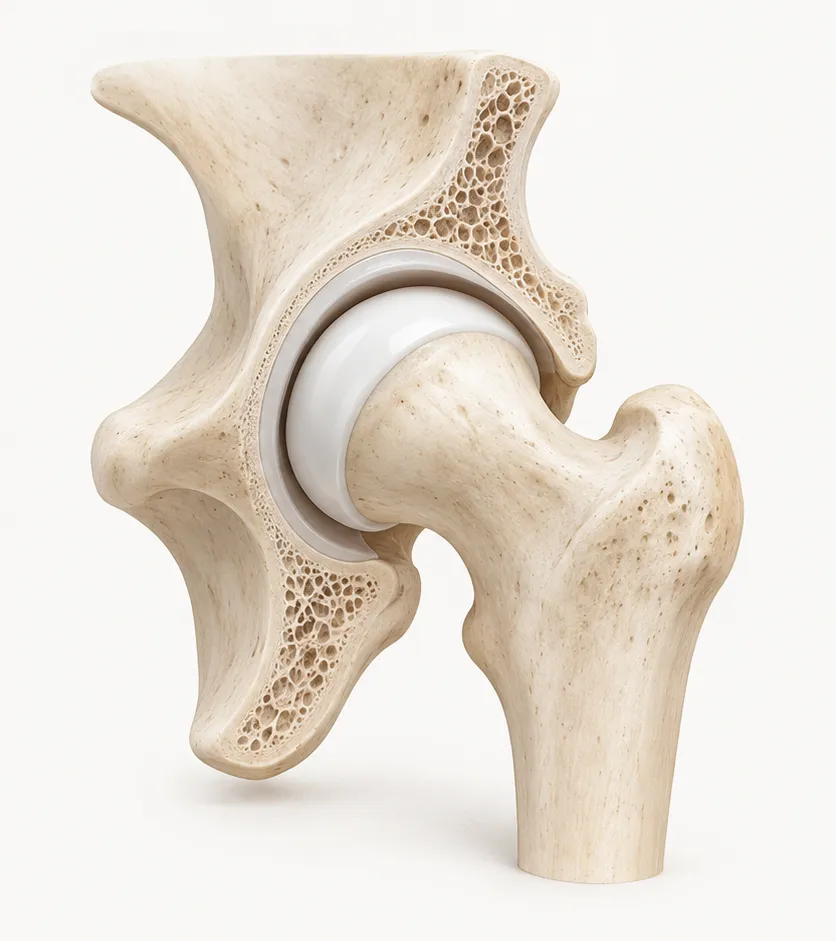
The hip is the largest ball-and-socket joint in the body. The head of the thigh bone (the ball) sits in the pelvic socket (acetabulum). Both surfaces are covered with smooth cartilage, so the bones glide almost without friction. The capsule and ligaments hold the ball in the socket. The buttock, groin and hip flexor muscles move the leg and steady the joint.[2]2Total Hip Replacement — AAOS OrthoInfo, 2024To the list of sources →
When the cartilage wears thin, the bones start to rub against each other. Pain, stiffness and a limp follow. The implant replaces exactly this worn ball-and-socket pair.
Causes and stages
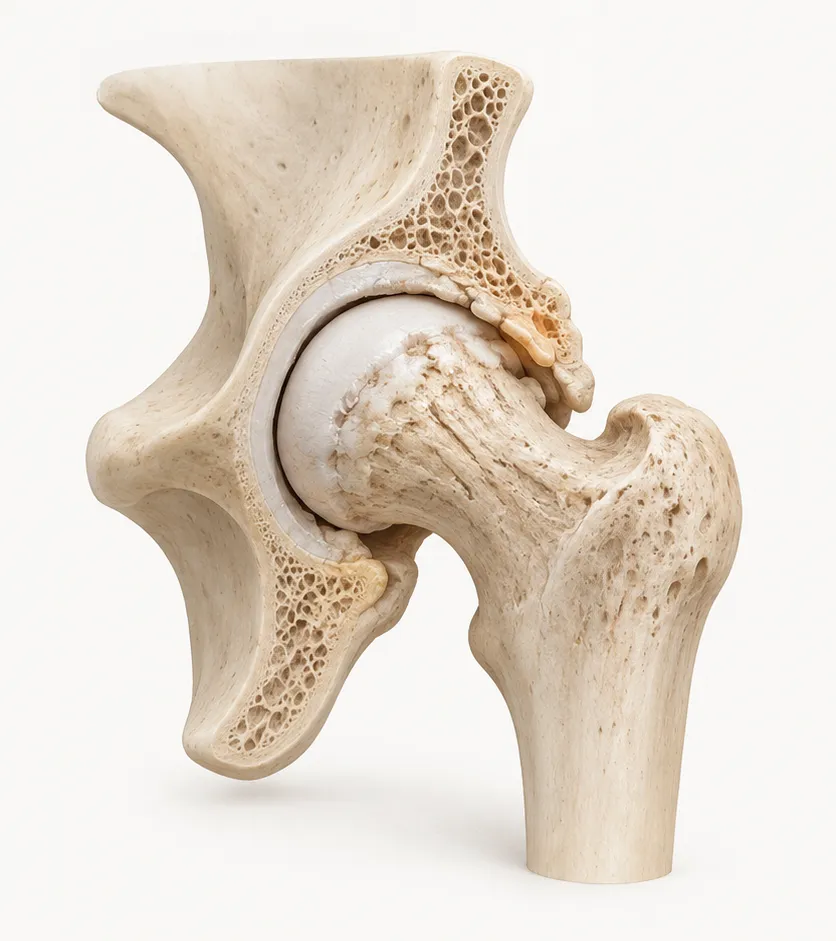
The most common cause is coxarthrosis, or osteoarthritis of the hip. Cartilage wears away with age, overload or injury.[8]8Клинические рекомендации «Коксартроз» (ID 870_1) — Минздрав России, 2024To the list of sources → Other causes:
- dysplasia: a shallow socket from birth that makes the joint wear out early;
- avascular necrosis: part of the femoral head dies from a poor blood supply. Causes include injury, steroid medicines and some diseases;
- hip fracture, especially in older people;
- rheumatoid arthritis and other inflammatory joint diseases;
- post-traumatic arthritis after fractures of the socket.[2]2Total Hip Replacement — AAOS OrthoInfo, 2024To the list of sources →
Stages are graded on X-rays. Russia uses two scales: Kosinskaya (stages I–III) and Kellgren–Lawrence (grades 0–IV).[8]8Клинические рекомендации «Коксартроз» (ID 870_1) — Минздрав России, 2024To the list of sources → The higher the stage, the narrower the joint space and the larger the bone spurs. The decision to operate rests on how the pain affects your life. The stage on the image does not decide it alone.
In Russia more than 83,000 primary hip replacements were done in 2019.[5]5Эпидемиология эндопротезирования тазобедренного и коленного суставов и перипротезной инфекции в Российской Федерации — Травматология и ортопедия России, 27(3):84–93, 2021To the list of sources →
2Decide
Indications for surgery
The Russian Ministry of Health guideline on coxarthrosis (2024) discusses replacement when two conditions meet:
- the X-ray shows Kosinskaya stage III or Kellgren–Lawrence grade III–IV;
- treatment without surgery no longer helps: exercise, weight loss, painkillers, injections.[8]8Клинические рекомендации «Коксартроз» (ID 870_1) — Минздрав России, 2024To the list of sources →
For the appointment: ticked statements
Statements are based on clinical guidelines and patient information[2, 8]2Total Hip Replacement — AAOS OrthoInfo, 20248Клинические рекомендации «Коксартроз» (ID 870_1) — Минздрав России, 2024To the list of sources →
What this means
Tick what applies to you
0 of 7 ticked
This is not a diagnosis — a guide for talking to your doctor
There is no absolute age or weight limit: the doctor looks at your overall health.[2]2Total Hip Replacement — AAOS OrthoInfo, 2024To the list of sources → Surgery is postponed with an active infection, including of the teeth or skin. Untreated severe heart or lung disease and untreated severe osteoporosis are other reasons to wait. So is being unable to go through rehabilitation.[8]8Клинические рекомендации «Коксартроз» (ID 870_1) — Минздрав России, 2024To the list of sources →
The navigator is not a doctor: diagnosis and treatment stay with your physician.
Questions about this chapter
When is a hip replacement needed, and can it be postponed?
Surgery is discussed at Kosinskaya stage III, when exercise, weight loss and painkillers no longer help. You can wait if the pain is bearable and you stay active. If pain wakes you at night and stops you walking, waiting weakens the muscles and makes rehabilitation harder.
3Surgery
Types of operation
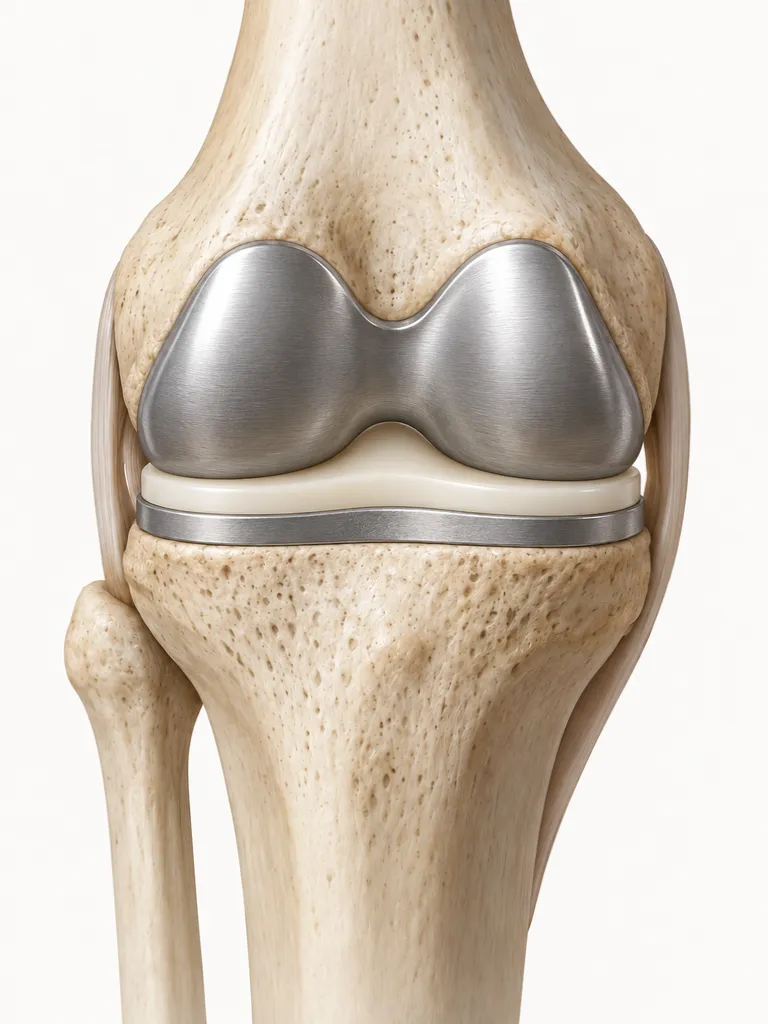
- Total hip replacement: the socket and the head with a stem are both replaced. It is the main operation for coxarthrosis.[2]2Total Hip Replacement — AAOS OrthoInfo, 2024To the list of sources →
- Hemiarthroplasty: only the femoral head is replaced, and your own socket stays. It is usually done for hip fractures, rarely for tumours.[1]1Hip Replacement — Cleveland Clinic, 2025To the list of sources →
- Hip resurfacing: the head is not removed but capped with a metal shell. It is used less now because of problems with metal-on-metal bearings. Candidates are mostly under 60 with strong bone, more often men.[15]15Hip Resurfacing — AAOS OrthoInfo, 2024To the list of sources →
- Revision replacement: a repeat operation to replace worn or loose parts. It is harder than a first operation and carries more risk, including infection.[4]4Periprosthetic joint infection after 1.66 million primary and revision arthroplasties (2015–2023) — PMC, 2025To the list of sources →
Robot and navigation
1 min
Robotic and navigation assistance exists for hip replacement. It is a tool for placing the implant precisely, rather than a different operation. In a 2025 meta-analysis the cup was placed more accurately, but surgery took longer. Pain, function and repeat operations did not differ from the conventional technique.[10]10Robotic versus conventional total hip arthroplasty: systematic review and meta-analysis — The Journal of Arthroplasty (PMID 39710214), 2025To the list of sources → More on the robotic joint replacement page.
Surgical approach
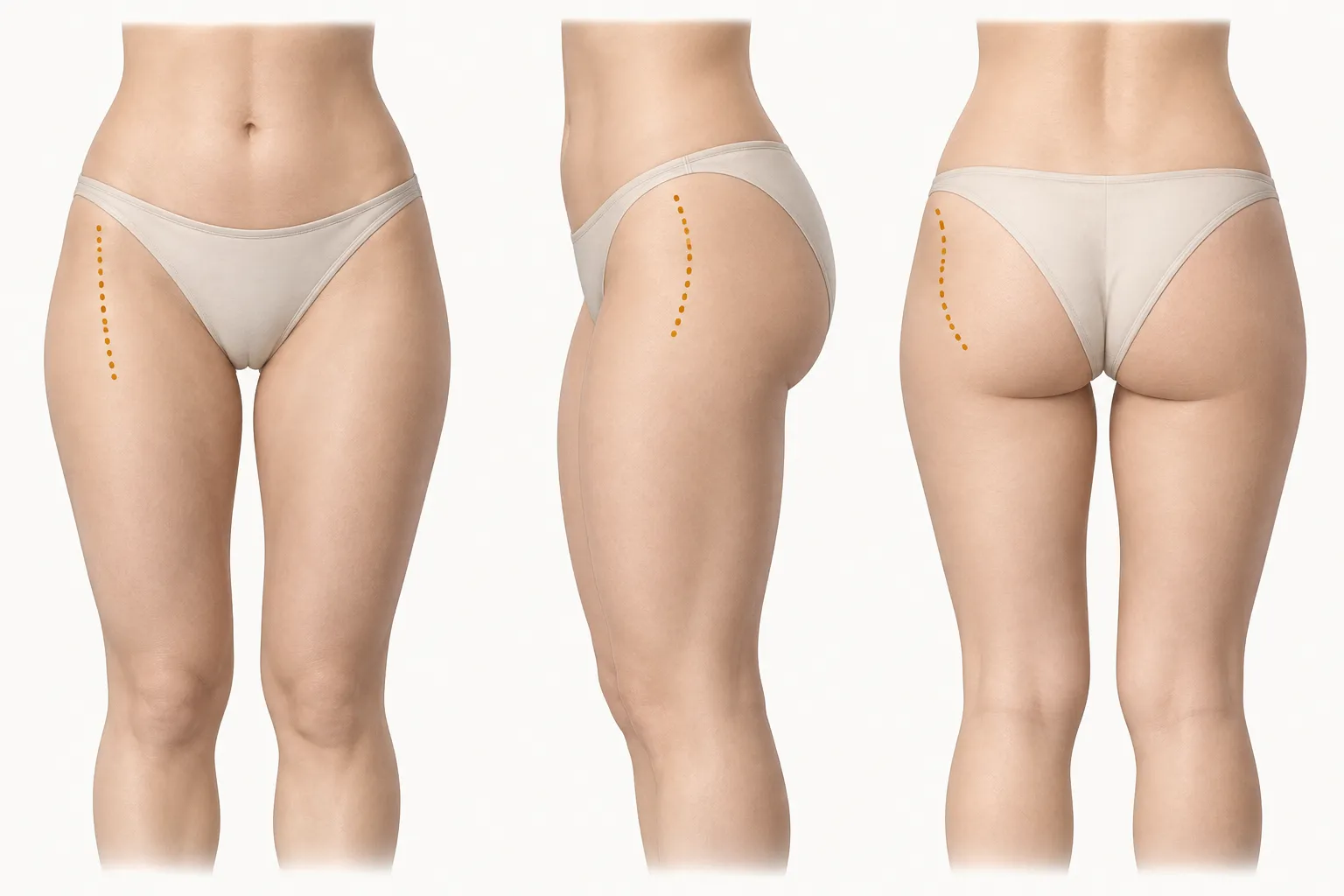
The approach is the route to the joint: the incision site and the muscles moved or cut.[13]13Surgical approaches for total hip arthroplasty: a review of the anatomy (direct lateral / Hardinge, anterolateral, posterior, direct anterior) — PMC, 2015To the list of sources → It shapes the first weeks of recovery and the safety rules. It does not change how long the implant lasts.
Posterior or anterior approach
How they differ
The anterior approach is gentler on the muscles, with fewer dislocations and earlier discharge; the posterior approach gives the surgeon a good view of the joint. The surgeon’s experience with an approach matters more than the approach itself.
Dislocation rates in numbers are in «Complications and how often they happen».
Another approach
Direct lateral (Hardinge). Incision on the side; part of the gluteus medius muscle is split. Dislocations are rare, but weakness of the muscles that move the leg outwards and a limp can follow[13]13Surgical approaches for total hip arthroplasty: a review of the anatomy (direct lateral / Hardinge, anterolateral, posterior, direct anterior) — PMC, 2015To the list of sources →
The comparison figures come from a meta-analysis of 48 studies and 46,367 hips.[3]3Direct anterior versus posterior approach in total hip arthroplasty: systematic review and meta-analysis — Frontiers in Surgery, 2025To the list of sources → The anterior approach gives a small early gain in function: about 3 points of 100 on the Harris Hip Score. The difference fades over time. Skin nerve injury rates with the anterior approach did not differ in the meta-analysis.[3]3Direct anterior versus posterior approach in total hip arthroplasty: systematic review and meta-analysis — Frontiers in Surgery, 2025To the list of sources → Ask your surgeon how many operations they do a year with the chosen approach.
What you will be given
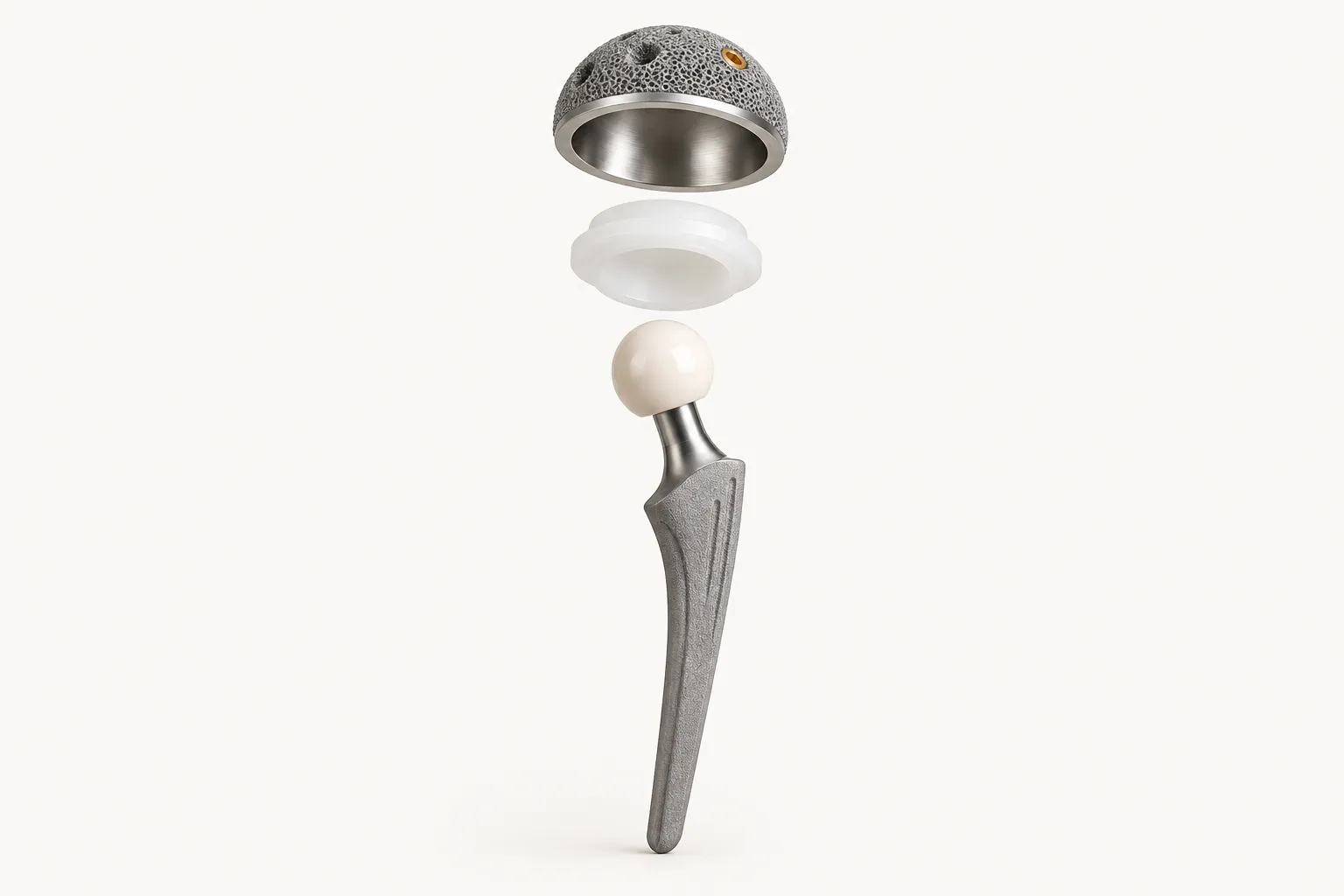
A hip implant has four parts:
- Cup (acetabular component): a metal hemisphere fitted into the prepared socket. It is usually porous titanium alloy, so bone can grow into it.
- Liner: a polyethylene or ceramic insert inside the cup. The head moves against it.
- Head: a ball of ceramic or cobalt-chrome alloy, usually 28, 32 or 36 mm across.
- Stem (femoral component): a metal rod inside the canal of the thigh bone. The head fits onto its tapered end.[2]2Total Hip Replacement — AAOS OrthoInfo, 2024To the list of sources →
Bearing couples
2 min
The bearing couple is the pair of materials of the head and liner. It determines wear and how long the implant lasts.
| Bearing couple | Wear | Notes | Typically offered to |
|---|---|---|---|
| Metal on cross-linked polyethylene | Low | Proven over decades, the standard in most clinics | Most patients |
| Ceramic on polyethylene | Very low | Ceramic is scratch-resistant | Younger, more active patients |
| Ceramic on ceramic | Minimal | Occasional squeak; very rarely a fracture; no proven revision advantage | Young patients with high activity |
| Metal on metal | — | Practically no longer used in standard total hip replacement because of tissue reactions to metal particles; a few indications remain for hip resurfacing | — |
Sources: AAOS OrthoInfo, 2024; NHS, 2024; PubMed, 2026
A meta-analysis of 33 studies and about 120,000 operations compared ceramic-on-ceramic with polyethylene bearings. Dislocations were less common with ceramic. Revision, loosening and fractures around the implant did not differ.[16]16Ceramic-on-ceramic versus other bearing surfaces in total hip arthroplasty: systematic review and meta-analysis (33 studies, ~120 000 THA) — PubMed, 2026To the list of sources → Ceramic wears less, but it has not been shown to last longer. Ask your surgeon which couple their clinic uses and why.
Head size and dual mobility
2 min
A 28 mm head was the standard for decades. Today 32 and 36 mm heads are more common. A bigger ball must travel further to leave the cup, and it allows more movement. The price is slightly more liner wear and more load on the stem’s taper. In a systematic review, revision rates with 36 mm and 32 mm heads on polyethylene were close. For ceramic-on-polyethylene: 4.0 % versus 4.2 %. For metal-on-polyethylene: 4.3 % versus 5.3 %.[17]1736 mm versus 32 mm femoral heads on polyethylene in total hip arthroplasty: systematic review — PMC, 2025To the list of sources →
Dual mobility is a design in which the polyethylene liner rotates freely inside the metal cup, with a small head inside the liner. The result is a ball in a ball. It is offered to people with a higher dislocation risk: older patients, hip fractures, previous spine surgery. Weak muscles, neuromuscular disease and revisions are other reasons. Registries show fewer dislocations with it. Long-term risks of older designs, such as a dislocation inside the implant, are still being studied.[18]18Dual mobility cups in total hip arthroplasty: narrative review — Clinical Interventions in Aging (Taylor & Francis), 2025To the list of sources →
Fixation: cemented, cementless or hybrid
1 min
- Cementless (press-fit): porous parts are pressed firmly into bone, which grows into them over a few weeks. Usually chosen for younger, active patients with strong bone.[2]2Total Hip Replacement — AAOS OrthoInfo, 2024To the list of sources →
- Cemented: parts are fixed with fast-setting bone cement. The implant holds at once. So this method suits osteoporosis and older age, when fragile bone may not withstand a tight fit.[2]2Total Hip Replacement — AAOS OrthoInfo, 2024To the list of sources →
- Hybrid: a cementless cup and a cemented stem. A common choice in older patients, when the cup holds well but the thigh bone is weaker.[2]2Total Hip Replacement — AAOS OrthoInfo, 2024To the list of sources →
The choice depends on age and bone quality on X-rays and during surgery. Sometimes it also depends on which implants were bought under a quota. No method is best for everyone.
Preparation
Preparation starts several weeks before the operation.[2, 8]2Total Hip Replacement — AAOS OrthoInfo, 20248Клинические рекомендации «Коксартроз» (ID 870_1) — Минздрав России, 2024To the list of sources →
A few more points:
- Skin. Treat any skin infections: infection can spread to the implant.
- Smoking. Stop smoking: it slows healing.
- Weight. Ask your doctor whether you should lose weight.
- Prehabilitation. Strengthen your legs and arms, since you will lean on them. Practise walking with crutches.
- Home. Bathroom grab rails, a raised toilet seat, slip-on shoes and a long shoehorn.[2, 8]2Total Hip Replacement — AAOS OrthoInfo, 20248Клинические рекомендации «Коксартроз» (ID 870_1) — Минздрав России, 2024To the list of sources →
The day of surgery
Spinal anaesthesia is used most often. An injection in the back numbs the legs, and you can doze. General anaesthesia is used less often. The anaesthetist chooses the method with you.[2]2Total Hip Replacement — AAOS OrthoInfo, 2024To the list of sources →
How hip replacement is performed
Step 1. Access to the joint
An incision at the front, side or back of the hip depending on the chosen approach.
Step 2. Removing the femoral head
The worn ball of the femur is cut and removed.
Step 3. Preparing the socket
The acetabulum is reamed to size and the cup with its liner is fitted.
Step 4. Stem and head
The stem is inserted into the femoral canal, the new head is attached and reduced into the cup.
Step 5. Check and closure
Leg length, stability and range of motion are checked, then the wound is closed.
The operation usually takes 1–2 hours.[1]1Hip Replacement — Cleveland Clinic, 2025To the list of sources → An antibiotic is given before the incision. Medicines against blood clots are prescribed after surgery.[8]8Клинические рекомендации «Коксартроз» (ID 870_1) — Минздрав России, 2024To the list of sources →
In hospital
On day one you are helped to sit, then to stand with a walker.[2]2Total Hip Replacement — AAOS OrthoInfo, 2024To the list of sources → Walking early lowers the risk of clots and pneumonia.
- Days 0–1. First steps with a walker or crutches. Ankle pumps: bend and straighten the ankles.[11]11Total Hip Replacement Exercise Guide — AAOS OrthoInfo, 2024To the list of sources →
- Days 2–3. Walking in the ward and corridor. Learning to use a high chair and toilet, and a sock aid.
- Days 3–5. Stairs with a physiotherapist.
- Before discharge. A check X-ray, training in the safety rules, anticoagulants and a rehabilitation plan.[8]8Клинические рекомендации «Коксартроз» (ID 870_1) — Минздрав России, 2024To the list of sources →
In the UK patients go home after 1–3 days.[9]9Hip replacement — NHS, 2024To the list of sources → In the US they often leave on the day of surgery or the next day.[2]2Total Hip Replacement — AAOS OrthoInfo, 2024To the list of sources → In Russian clinics the early inpatient stage lasts up to 1–2 weeks.[8]8Клинические рекомендации «Коксартроз» (ID 870_1) — Минздрав России, 2024To the list of sources → Private clinics discharge sooner. Pain after surgery is normal and is treated with several medicines at once. Do not put up with it: tell the nurse.
Questions about this chapter
How long does the operation take and how long is the hospital stay?
The operation usually takes 1–2 hours under spinal or general anaesthesia. In the UK patients go home after 1–3 days, in the US often the next day. In Russian clinics the early inpatient stage takes up to 1–2 weeks; private clinics are shorter.
4Recovery
Recovery plan
Optional. Enter how many full weeks have passed since the operation and we will mark the stage. The number stays in this tab only.
First 6–12 weeks
The 90° rule: do not bend the hip beyond a right angle, do not cross your legs. Your surgeon says which movements to limit for your approach[8, 9]8Клинические рекомендации «Коксартроз» (ID 870_1) — Минздрав России, 20249Hip replacement — NHS, 2024To the list of sources →
- Weeks 0–2You are here
- Walking with a frame or crutches, stairs, looking after yourself[8]8Клинические рекомендации «Коксартроз» (ID 870_1) — Минздрав России, 2024To the list of sources →
- Stitches or clips come out after about 10–14 days[8, 9]8Клинические рекомендации «Коксартроз» (ID 870_1) — Минздрав России, 20249Hip replacement — NHS, 2024To the list of sources →
- Blood-clot prevention as your doctor prescribes[8]8Клинические рекомендации «Коксартроз» (ID 870_1) — Минздрав России, 2024To the list of sources →
- Weeks 2–6You are here
- From crutches to a stick, walks, light housework[8]8Клинические рекомендации «Коксартроз» (ID 870_1) — Минздрав России, 2024To the list of sources →
- The second stage of rehabilitation — in a unit or a day hospital[8]8Клинические рекомендации «Коксартроз» (ID 870_1) — Минздрав России, 2024To the list of sources →
- Weeks 6–12You are here
- Follow-up appointment with the surgeon after 6–12 weeks[9]9Hip replacement — NHS, 2024To the list of sources →
- Driving no sooner than 6 weeks, and after your doctor confirms you are fit to drive[9]9Hip replacement — NHS, 2024To the list of sources →
- Work usually after about 6 weeks, depending on the kind of work[9]9Hip replacement — NHS, 2024To the list of sources →
- Sex after 6–8 weeks[9]9Hip replacement — NHS, 2024To the list of sources →
- Months 3–12You are here
- Follow-up X-rays at 3 and 12 months, then every 5 years[8]8Клинические рекомендации «Коксартроз» (ID 870_1) — Минздрав России, 2024To the list of sources →
- The final result is assessed over the first year[8]8Клинические рекомендации «Коксартроз» (ID 870_1) — Минздрав России, 2024To the list of sources →
A guide based on the NHS and Russian clinical guidelines; your surgeon may change the timings[9, 8]9Hip replacement — NHS, 20248Клинические рекомендации «Коксартроз» (ID 870_1) — Минздрав России, 2024To the list of sources →
Driving, work and swimming in detail
1 min
A systematic review found that patients return to driving after 4 weeks on average, with a range of 2 to 8.[12]12Return to driving after hip and knee arthroplasty: systematic review — PMC, 2020To the list of sources → That is an average from studies, not a permission. You can drive when the pedals cause no pain and you move your foot from accelerator to brake without delay. Two more conditions: you take no strong painkillers, and you get into the car following the safety rules. After a right-leg operation it takes longer.
The third stage of rehabilitation takes place as an outpatient or in a sanatorium. For physical jobs, your doctor decides when you go back to work. Swimming is fine once the wound has healed.
The 90° rule
While the capsule heals, an awkward movement can make the head slip out. Which movements are risky depends on the approach, so check with your surgeon. After the most common, posterior approach the rules are:[8, 9]8Клинические рекомендации «Коксартроз» (ID 870_1) — Минздрав России, 20249Hip replacement — NHS, 2024To the list of sources →
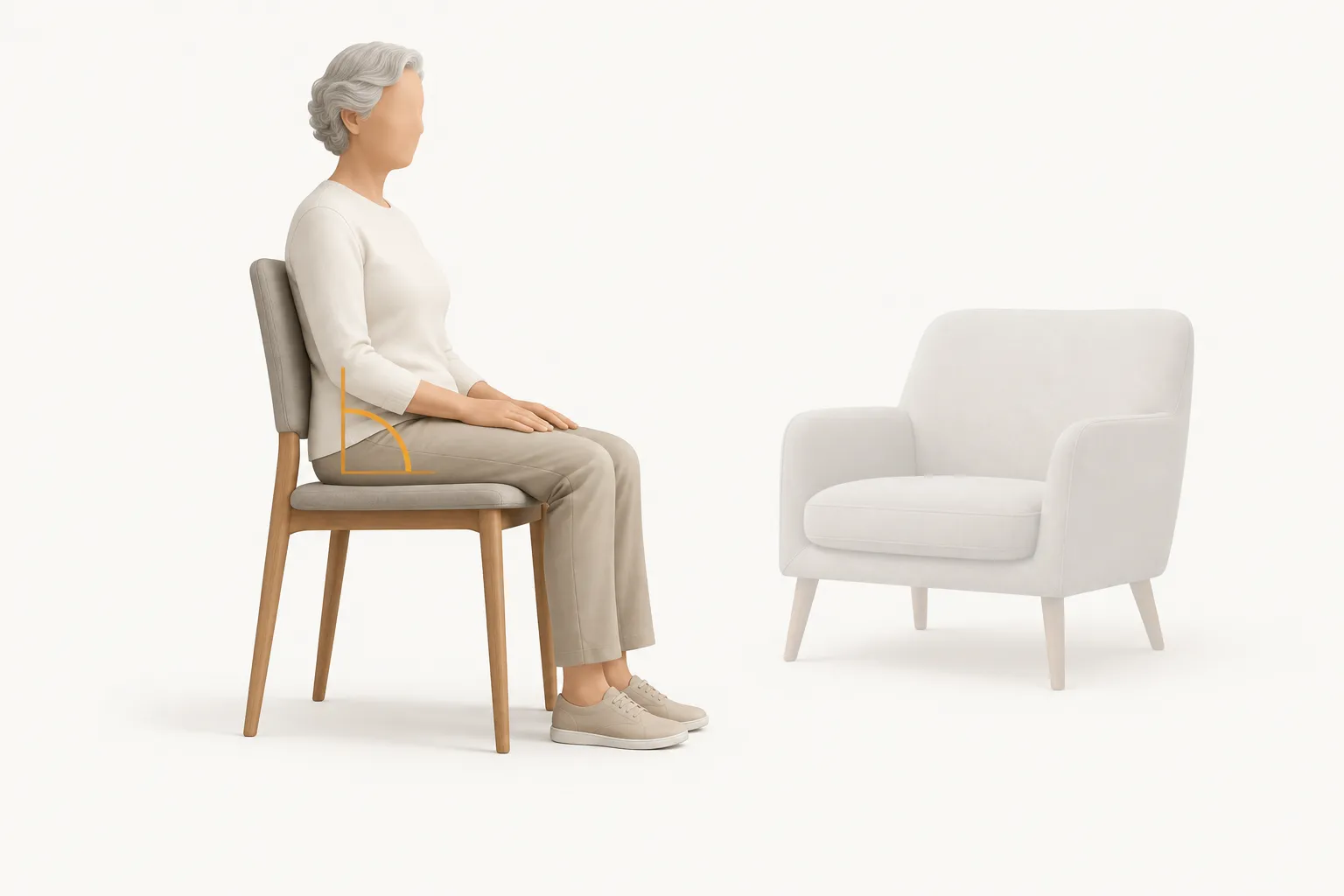
- Do not bend the hip beyond 90°. Do not bend down to your feet or sit on low seats.
- Do not cross the midline. Do not cross your legs. Sleep on your back, or on the healthy side with a 10–15° wedge between the knees.
- Do not turn the leg inwards. Your toes should not point at the other leg, especially when you turn your body.
After a direct anterior approach the rules are different and usually milder. Avoid over-extension, such as stepping back while leaning back. Avoid turning the leg outwards. Many clinics now relax the rules, but your surgeon decides. Unrestricted movement is usually allowed after 6–12 weeks.[1]1Hip Replacement — Cleveland Clinic, 2025To the list of sources →
Everyday tasks without risk
1 min
- Sitting and standing: use a high chair with armrests. Put the operated leg forward and push up with your arms.
- Socks and shoes: use a sock aid and a long shoehorn, without bending down. Wear slip-on shoes.
- Toilet: use a raised seat so it is higher than your knees.
- Car: move the seat back and recline it. Sit down backwards, then swing your legs in. Travel only as a passenger for the first weeks.
- Shower: a non-slip mat, a grab rail and a seat. Avoid the bath for the first weeks.
- Sleep: on your back, or on your side only with a pillow between the legs.
Exercises by phase
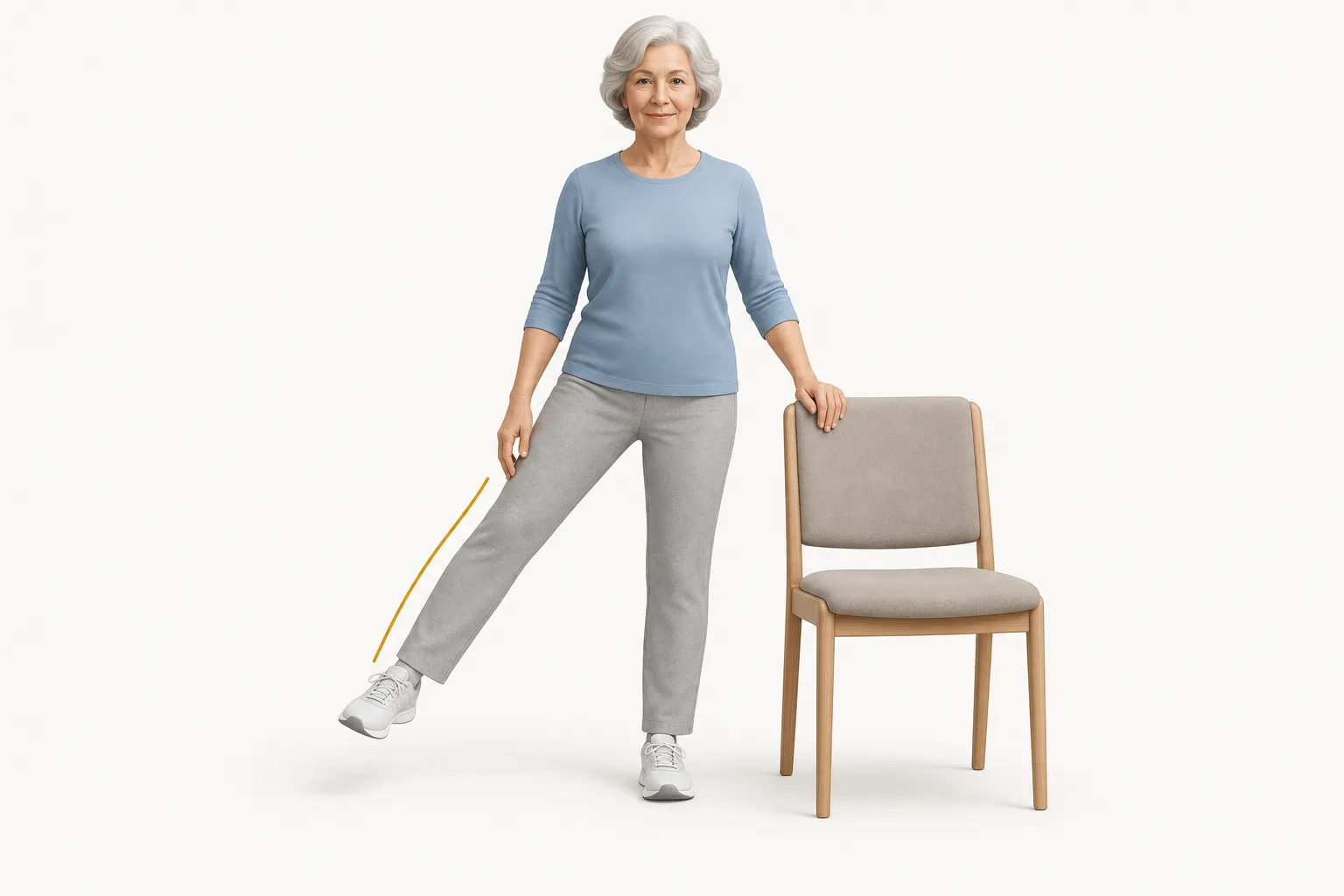
The programme follows the AAOS OrthoInfo guide.[11]11Total Hip Replacement Exercise Guide — AAOS OrthoInfo, 2024To the list of sources → Your physiotherapist will tailor it to you.
Phase 1. In bed in the first days, 5–10 minutes every hour
- ankle pumps: bend and straighten the ankles;
- ankle circles;
- knee bends, sliding the heel along the bed;
- tightening the buttock and thigh muscles for 5 seconds;
- moving the straight leg out to the side and back.
Phase 2. Standing with support, from the first weeks
- hip bends: lift the knee no higher than 90°;
- moving the leg out to the side;
- moving the leg back without leaning the body.
Phase 3. From 4–6 weeks
- walking, gradually adding distance;
- resistance-band exercises;
- an exercise bike with a high seat.
Muscle soreness is normal. Sharp joint pain or a painful click means stop and call your doctor.
Complications and how often they happen
Serious complications are rare.
| What can happen | How often | Source |
|---|---|---|
| Dislocation, anterior approach2025 meta-analysis; your personal risk and follow-up period may differ | 0.84% | [3]3Direct anterior versus posterior approach in total hip arthroplasty: systematic review and meta-analysis — Frontiers in Surgery, 2025To the list of sources → |
| Dislocation, posterior approachsame meta-analysis; the first 6–12 weeks matter most | 1.82% | [3]3Direct anterior versus posterior approach in total hip arthroplasty: systematic review and meta-analysis — Frontiers in Surgery, 2025To the list of sources → |
| Implant infectionfirst year after a primary operation, 1.66 million cases, USA | 1.28% | [4]4Periprosthetic joint infection after 1.66 million primary and revision arthroplasties (2015–2023) — PMC, 2025To the list of sources → |
| Infection after a revision operationfirst year | about 8.8% | [4]4Periprosthetic joint infection after 1.66 million primary and revision arthroplasties (2015–2023) — PMC, 2025To the list of sources → |
| Deep vein thrombosis and pulmonary embolismfirst 30 days with prophylaxis; after a revision about 1% | about 0.6% | [19]19Venous thromboembolism after total hip and knee arthroplasty: systematic review — PMC, 2020To the list of sources → |
Russian authors report an infection rate of about 3%; counting methods differ.[5]5Эпидемиология эндопротезирования тазобедренного и коленного суставов и перипротезной инфекции в Российской Федерации — Травматология и ортопедия России, 27(3):84–93, 2021To the list of sources →
Data verified
Diabetes, obesity, smoking and immune-suppressing medicines raise the risk of infection. Before surgery you can lose weight, stop smoking and control your blood sugar. That lowers the risk, though it does not remove it.
Other complications and what is done
1 min
- Dislocation. The joint is put back under anaesthesia. Repeated dislocations need a revision with a more stable cup.
- Infection. Treated with antibiotics, washing out the joint and replacing implant parts, sometimes in two stages.
- Thrombosis and pulmonary embolism. Rare with prophylaxis.[19]19Venous thromboembolism after total hip and knee arthroplasty: systematic review — PMC, 2020To the list of sources → Treatment is anticoagulants for 10–35 days, compression and early walking.[8]8Клинические рекомендации «Коксартроз» (ID 870_1) — Минздрав России, 2024To the list of sources →
- Fracture around the implant. Rare; the risk is higher with osteoporosis and after falls. The bone is fixed or the stem is replaced.[2]2Total Hip Replacement — AAOS OrthoInfo, 2024To the list of sources →
- Nerve and blood vessel injury. Rare. A vessel injury needs urgent assessment; nerve recovery depends on the type of injury.[2]2Total Hip Replacement — AAOS OrthoInfo, 2024To the list of sources →
- Loosening and wear. They grow with the years and are the main reason for late revisions. The treatment is revision surgery.[2]2Total Hip Replacement — AAOS OrthoInfo, 2024To the list of sources →
What to expect after a year
Most patients say the arthritis pain has gone. They return to walking, work and daily life.[2]2Total Hip Replacement — AAOS OrthoInfo, 2024To the list of sources →
- Leg length. The surgeon tries to make the legs equal. For stability, the operated leg sometimes ends up slightly longer. Often it is only a feeling after years of limping, and it passes. A true difference is corrected with an insole.[2]2Total Hip Replacement — AAOS OrthoInfo, 2024To the list of sources →
- Numbness around the scar and on the outer thigh usually fades over time.
- Clicks and squeaks. Soft clicks with some movements are normal. Ceramic-on-ceramic bearings can squeak, usually rarely and without pain. A new loud noise is a reason to see your surgeon.
- Sport. Walking, swimming, cycling, golf and classic cross-country skiing are fine. Running, jumping and contact sports speed up wear and are not recommended.[2]2Total Hip Replacement — AAOS OrthoInfo, 2024To the list of sources →
- Airport metal detectors may go off, which is normal. A certificate is not required, but you can carry your discharge summary.[2]2Total Hip Replacement — AAOS OrthoInfo, 2024To the list of sources →
- Dentist. Before procedures that cause bleeding, a preventive antibiotic may be prescribed. Discuss this with your surgeon and dentist.[2]2Total Hip Replacement — AAOS OrthoInfo, 2024To the list of sources →
Implant lifespan in detail
2 min
The largest analysis was done by Evans and colleagues (The Lancet, 2019). They used the Australian and Finnish registries, more than 215,000 operations. About 89 % of hip implants were still working at 15 years, about 70 % at 20 and about 58 % at 25.[6]6How long does a hip replacement last? A systematic review and meta-analysis of case series and national registry reports with more than 15 years of follow-up — The Lancet, 393(10172):647–654, 2019To the list of sources → Single-centre series do better, with about 78 % at 25 years.[6]6How long does a hip replacement last? A systematic review and meta-analysis of case series and national registry reports with more than 15 years of follow-up — The Lancet, 393(10172):647–654, 2019To the list of sources →
- If you are over 65–70, the implant usually lasts the rest of your life: a second operation is unlikely.
- If you are 50 or younger, the chance of a repeat operation in your lifetime is real. In registries about four implants in ten do not last 25 years, counting patients of all ages.[6]6How long does a hip replacement last? A systematic review and meta-analysis of case series and national registry reports with more than 15 years of follow-up — The Lancet, 393(10172):647–654, 2019To the list of sources → Young, active patients load the implant harder and for longer. That is a reason to discuss the bearing couple, fixation and activity level with your surgeon, rather than to refuse surgery.
- Registry figures describe implants fitted 15–25 years ago. Modern materials wear more slowly, but proving it will take another 25 years.
A promise of an implant for life, without an age qualifier, is not supported by registry data.
Questions about this chapter
When can I climb stairs and sleep on my side?
Stairs start on day 3–5 with a physiotherapist. For the first weeks sleep on your back; on your side only with a pillow between the knees, so the leg does not cross the midline. Timings depend on the approach, so check them with your surgeon.
Can I have an MRI, and can I fly?
An MRI is usually possible with modern implants: tell the radiologist about the implant and check with your surgeon. You can fly once your doctor allows it. On long flights move your legs and discuss clot prevention in advance.
5Paying
Hip replacement is part of the state guarantee programme. Most primary operations are paid by compulsory health insurance (OMS). Complex and revision cases go under a federal VMP quota.[7]7Травматология и ортопедия по квоте (ВМП): как получить — gosmed.ru, 2025To the list of sources →
You will need a referral on form 057/u and a medical summary.[14]14Приказ Минздрава России от 02.09.2025 № 519н: форма направления 057/у и порядок её ведения — Минздрав России, 2025To the list of sources → The route, documents and appeals are on the quota and OMS page.
A paid operation gives more choice, but it does not guarantee a better result.
Questions about this chapter
How do I get the operation free of charge, and can I choose the implant?
A polyclinic orthopaedic doctor issues a referral on form 057/u and a summary; standard OMS care needs no VMP voucher. Under a quota the implant comes from models the clinic has bought: you can ask about the bearing couple, but usually cannot order one. The wait is a few weeks to a year, depending on the region.