Knee replacement
When surgery is needed, what you will be given, how the day of surgery goes and what to expect a year on
Author: Bagrat DzhavakhyanTreatment navigator, portal author
Not yet reviewed by a physicianSources: Russian Ministry of Health guidelines 2024, NHS, AAOS[2, 5, 6]2Total Knee Replacement — AAOS OrthoInfo, 20245Knee replacement — NHS, 20246Клинические рекомендации «Гонартроз» — Минздрав России, 2024To the list of sources →
Your route: Back to your route
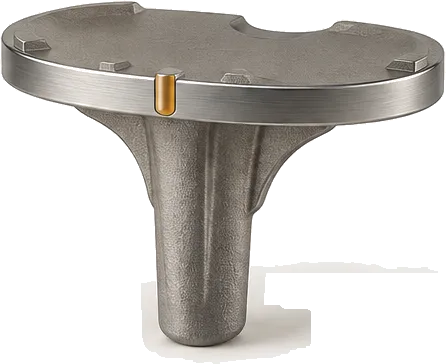
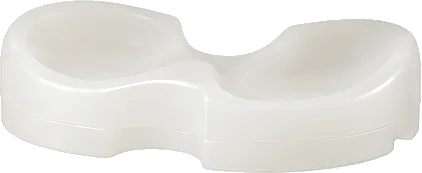
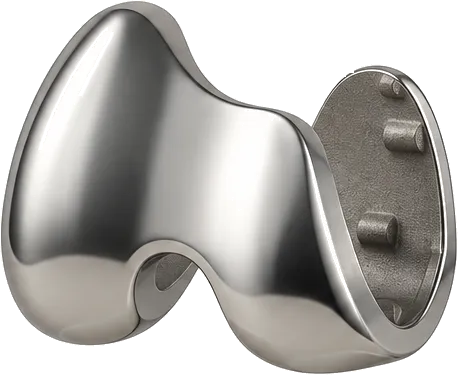
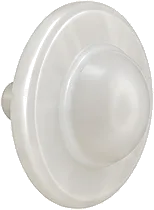
What the implant is made of
The parts of the implant, not the steps of the operation
- Tibial component — a metal base fixed to the top of the shin bone
- Polyethylene insert — lets the joint glide and carries the load
- Femoral component — a metal cap on the end of the thigh bone
- Button on the inner surface of the kneecap — not always used
In brief
- The operation takes 1–2 hours; you walk with support within the first day.
- In the Finnish registry about 82 % of total knee implants last 25 years.
- Implant infection in the first year is about 1.2 %; Russian authors report about 3 %.
- No driving for at least 6 weeks; the final result takes close to a year.
1Understand
How the knee is built
The knee is the largest joint in the body. Three bones meet here: the femur, the tibia and the kneecap (patella). The bone ends are covered with smooth, springy cartilage, so they glide almost without friction. Two cartilage pads, the menisci, lie between them and spread the load. The cruciate ligaments hold the bones from inside, the collateral ligaments from the sides. The synovial membrane lines the joint and produces lubricating fluid.[2]2Total Knee Replacement — AAOS OrthoInfo, 2024To the list of sources →
Surgeons divide the knee into three compartments:
- medial (inner): between the inner condyles of the femur and tibia; it wears out most often;
- lateral (outer): its mirror image on the outside;
- patellofemoral: between the kneecap and the front of the femur.
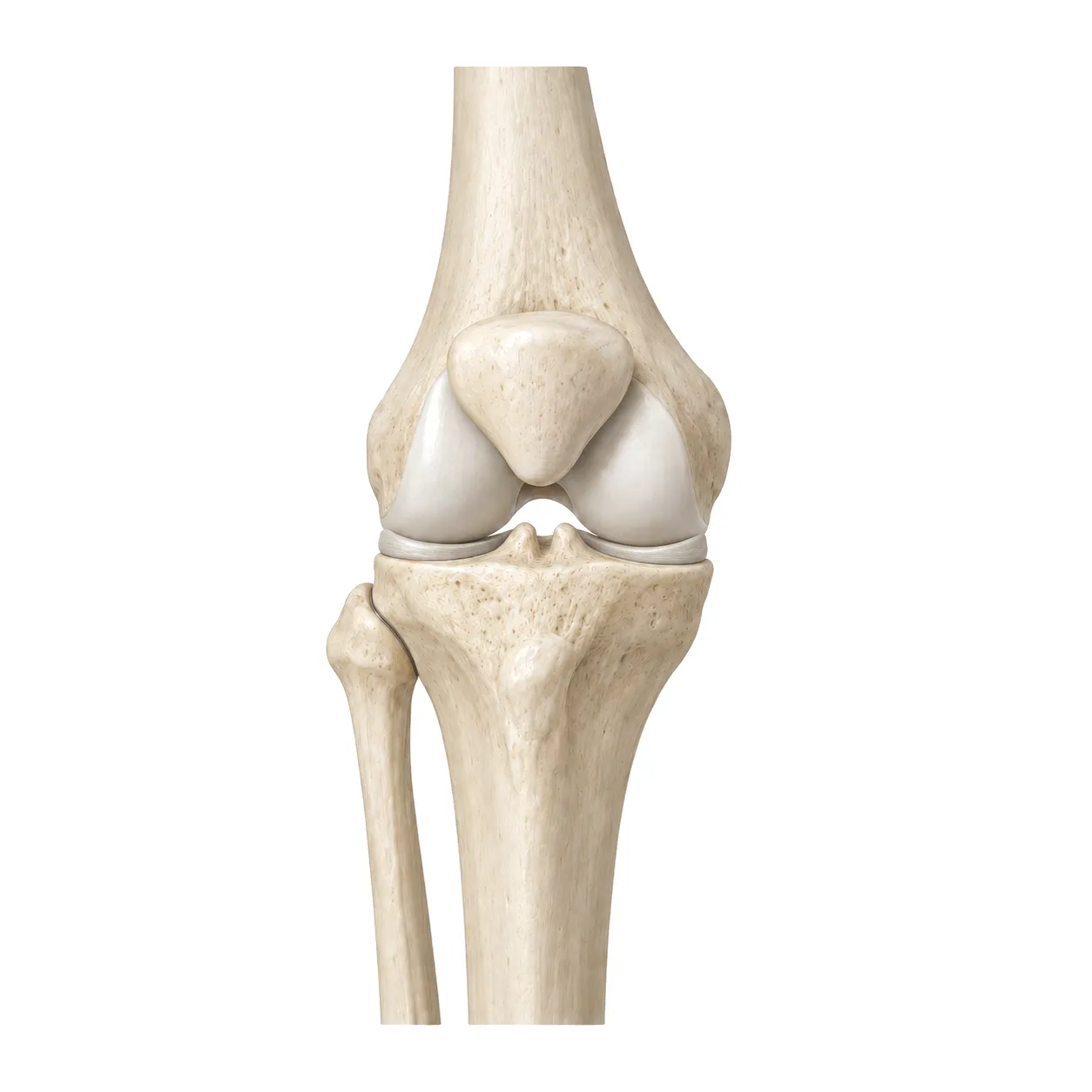
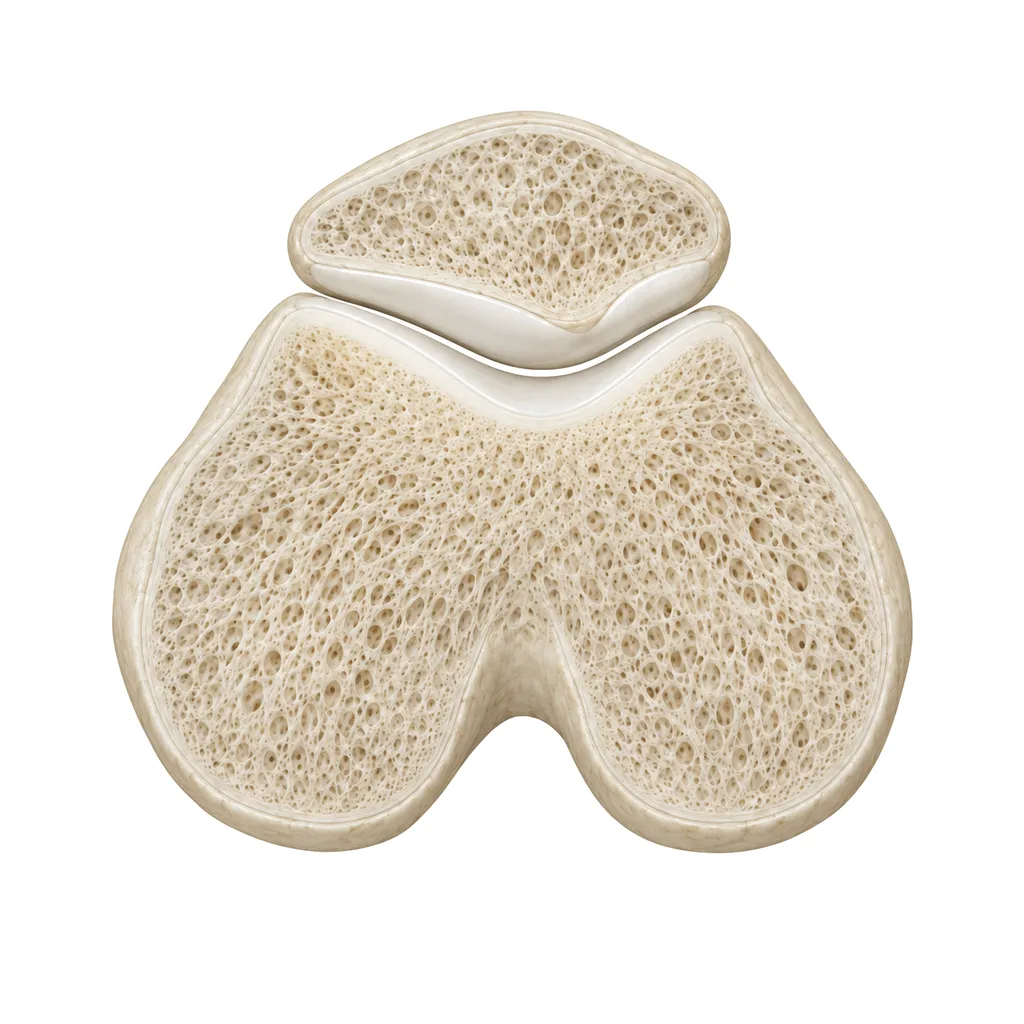
This division shapes the choice of operation. If one compartment is damaged, sometimes only that part is replaced. If all three are damaged, a total implant is needed.
Why the knee wears out
Gonarthrosis is osteoarthritis of the knee. The cartilage thins and the bone beneath it hardens and grows spurs. The joint deforms and hurts. The main causes are age-related wear and old injuries: fractures, torn menisci or ligaments. Rheumatoid arthritis and excess weight also lead to it. A bowed or knock-kneed leg, from birth or later in life, is another cause.[2, 6]2Total Knee Replacement — AAOS OrthoInfo, 20246Клинические рекомендации «Гонартроз» — Минздрав России, 2024To the list of sources →
Typical complaints:
- start-up pain in the first steps after sleep or sitting;
- stiffness that lasts no longer than half an hour;
- grinding, swelling, trouble with stairs;
- the knee bends and straightens less and less;
- in late stages, night pain and a visible deformity of the leg.[6]6Клинические рекомендации «Гонартроз» — Минздрав России, 2024To the list of sources →
In 2019 about 63,750 primary knee replacements were performed in Russia.[1]1Эпидемиология эндопротезирования тазобедренного и коленного суставов и перипротезной инфекции в Российской Федерации — Травматология и ортопедия России, 27(3):84–93, 2021To the list of sources →
Stages of osteoarthritis
The stage of osteoarthritis is judged from an X-ray. Russia uses two scales for this. The Kellgren–Lawrence scale has five grades, from 0 to IV. The Kosinskaya classification has three stages and takes symptoms into account as well as the X-ray.[6]6Клинические рекомендации «Гонартроз» — Минздрав России, 2024To the list of sources →
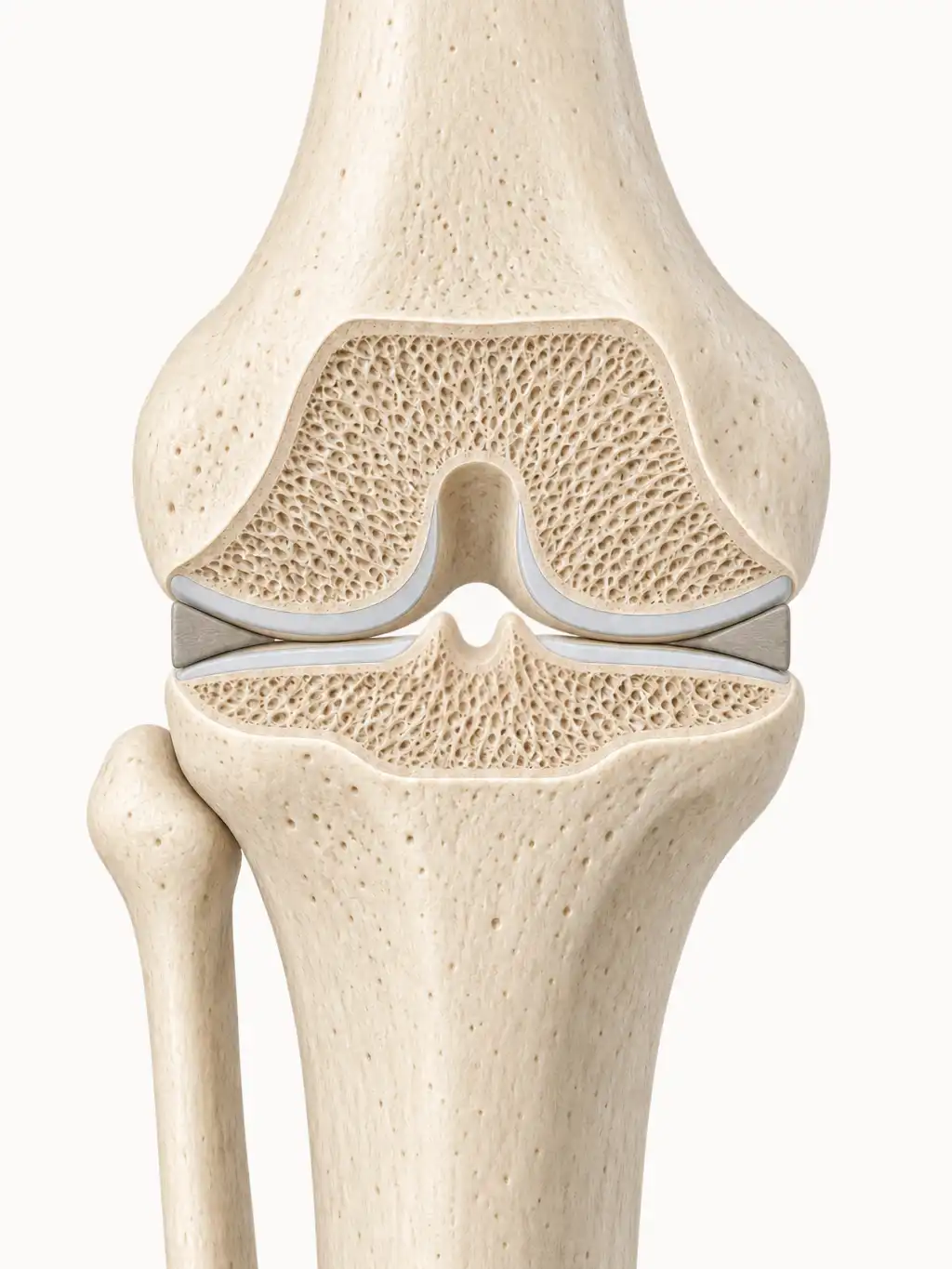
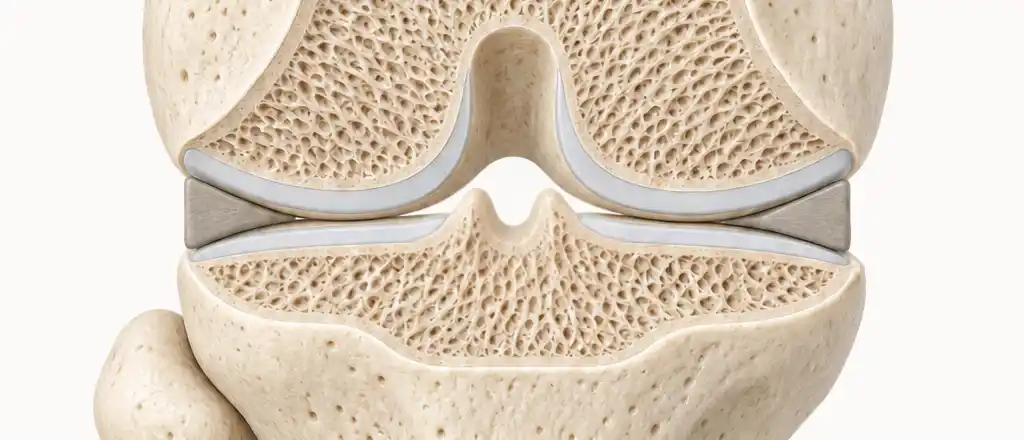
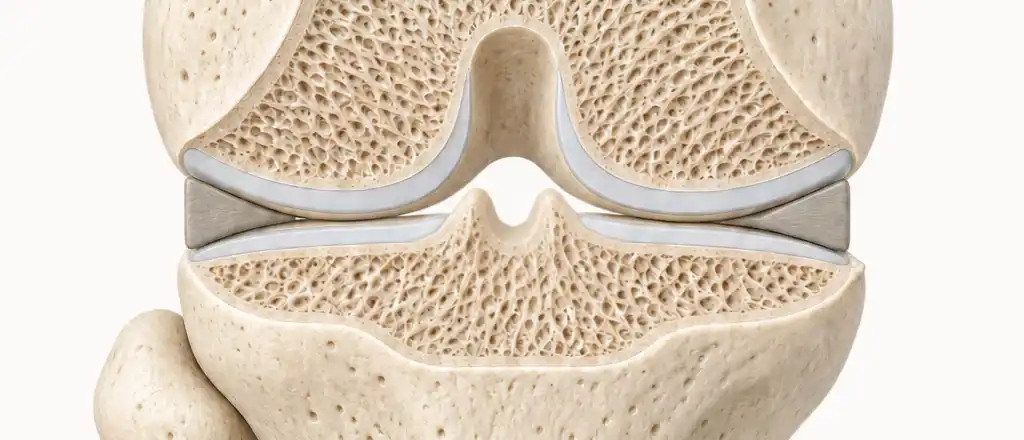
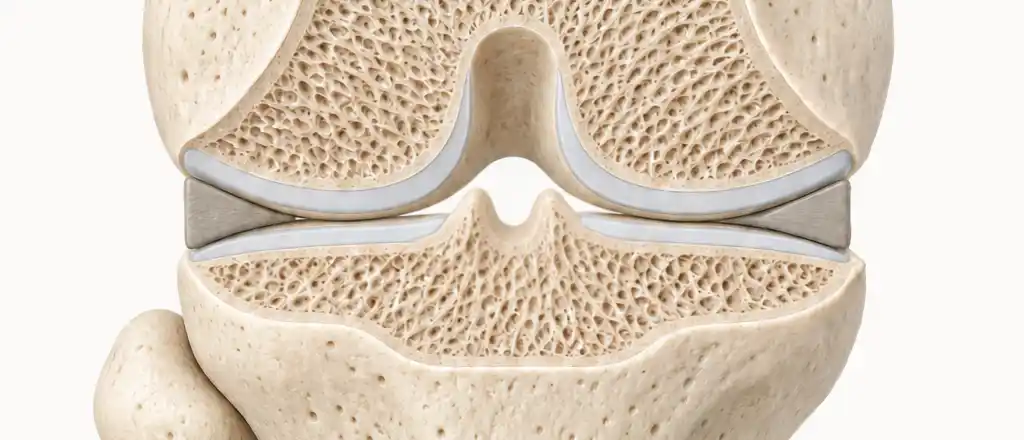
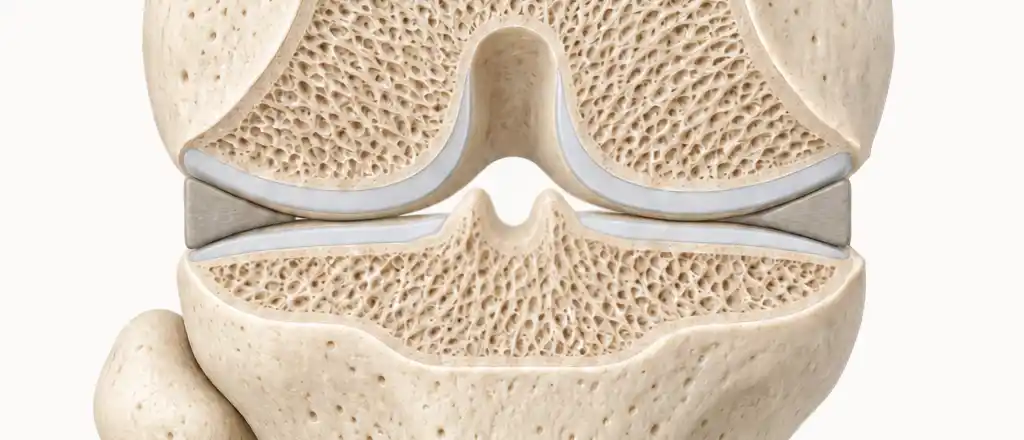
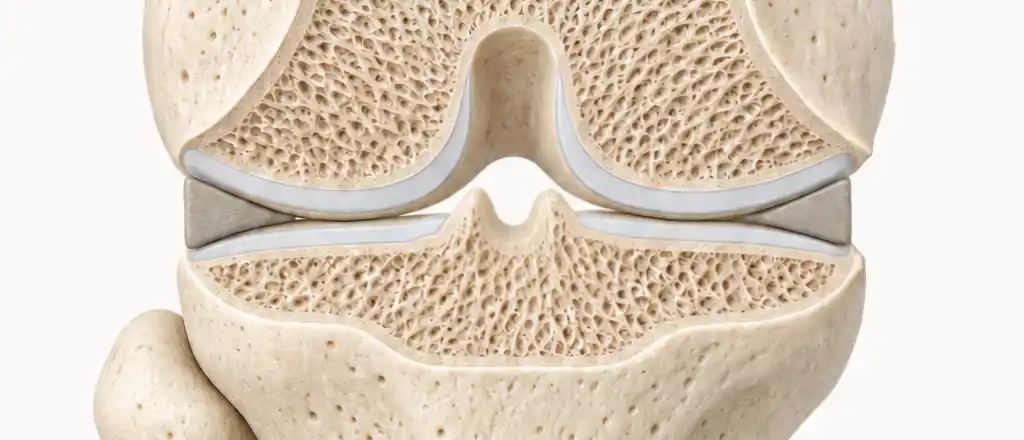
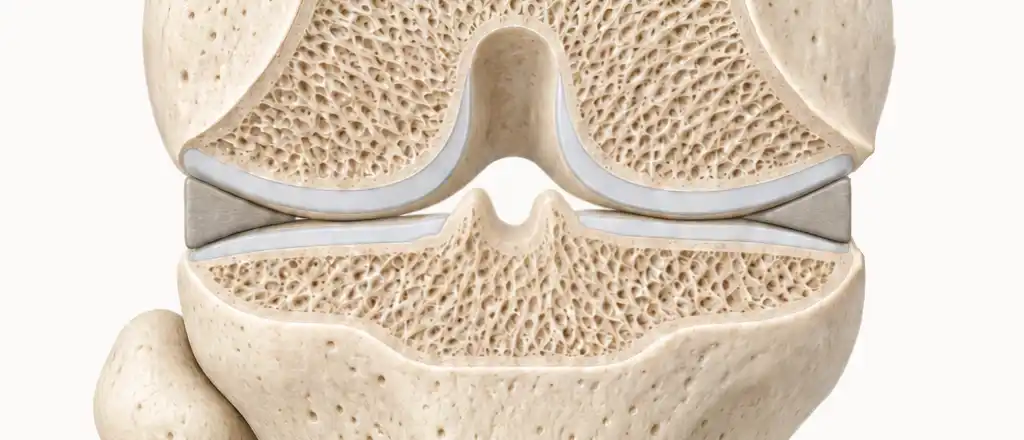
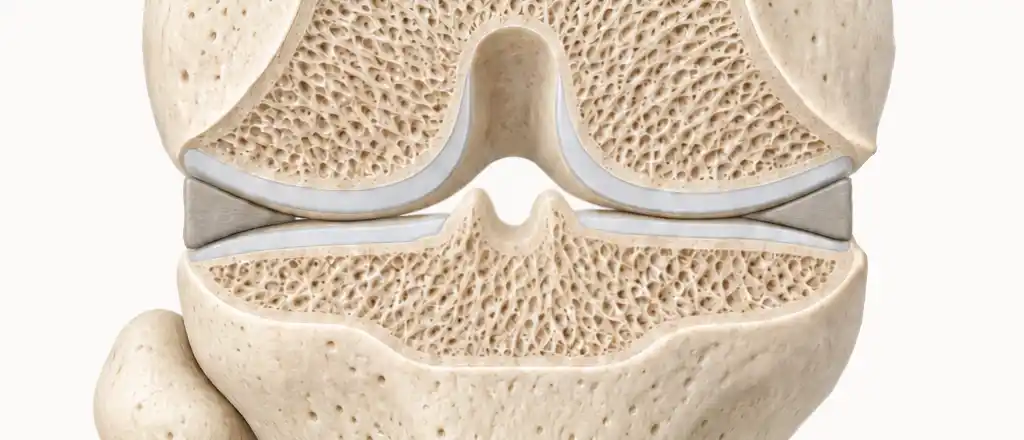
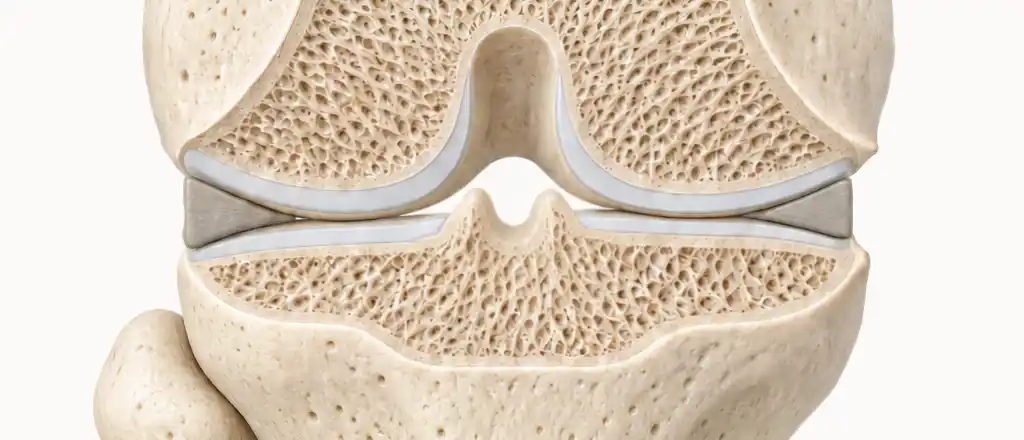
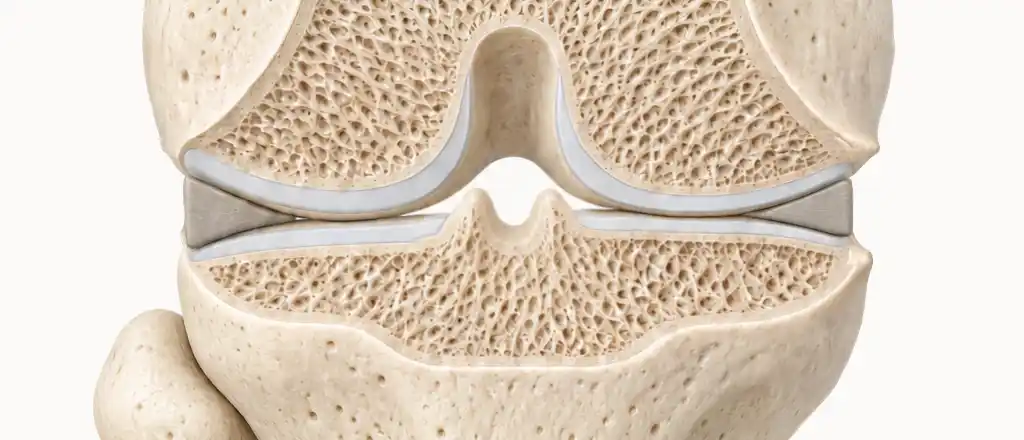
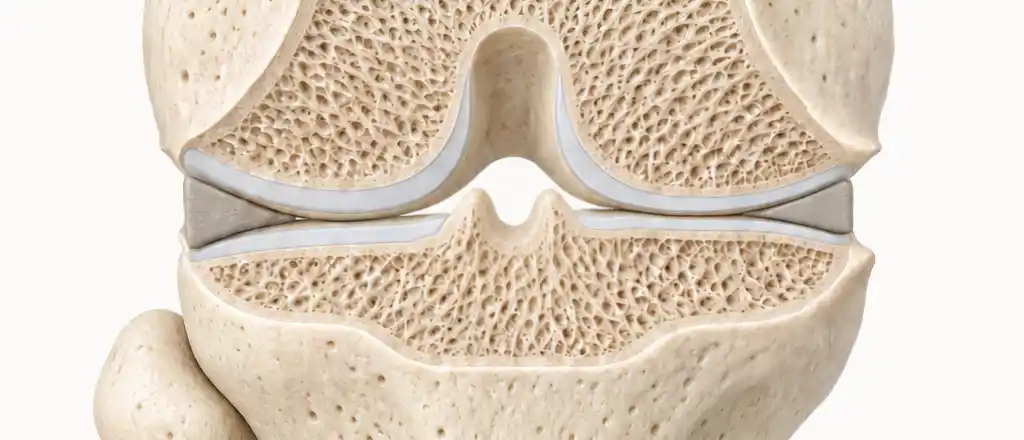
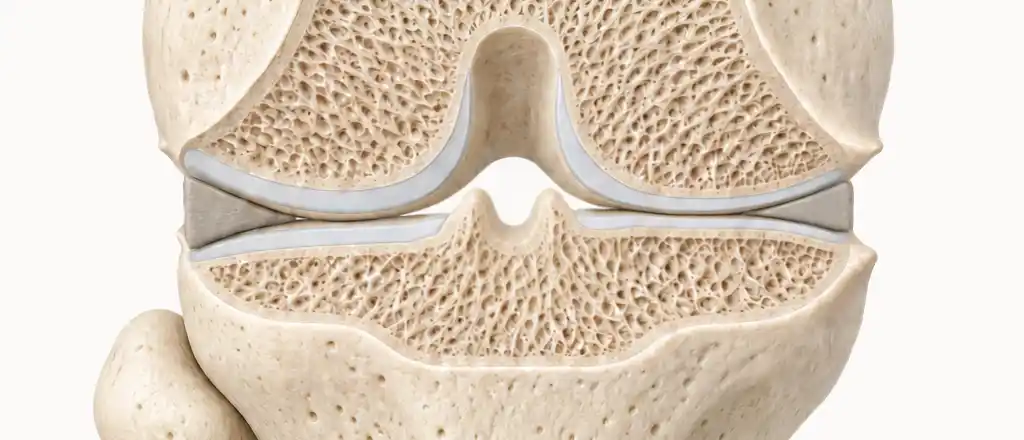
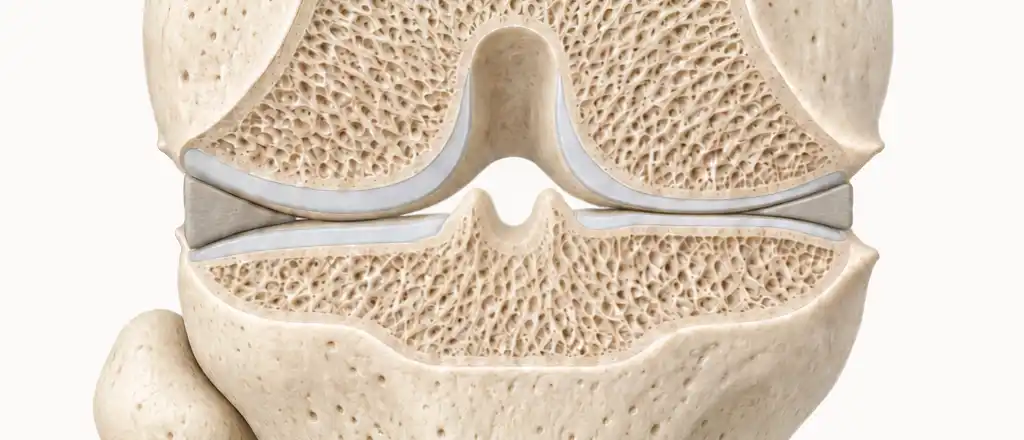
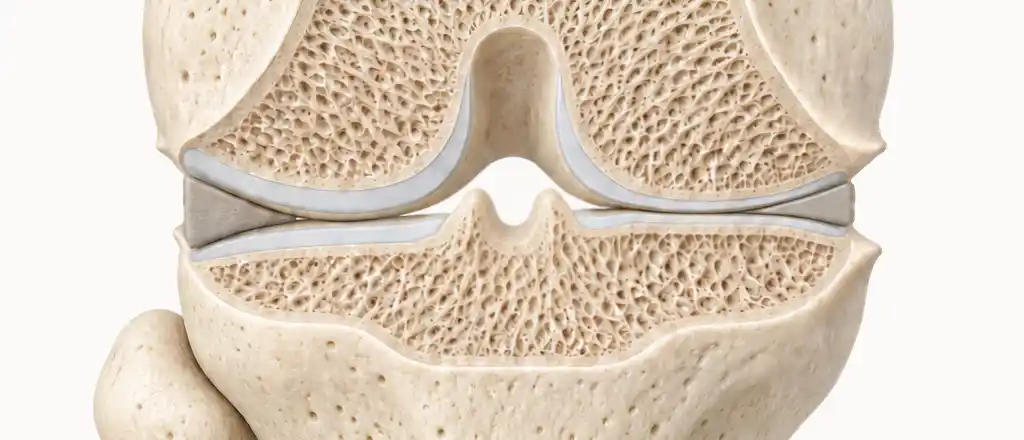
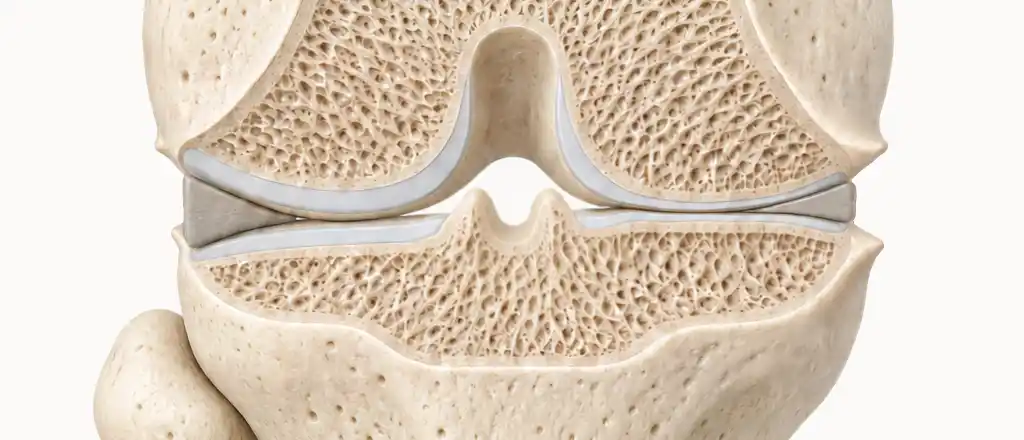
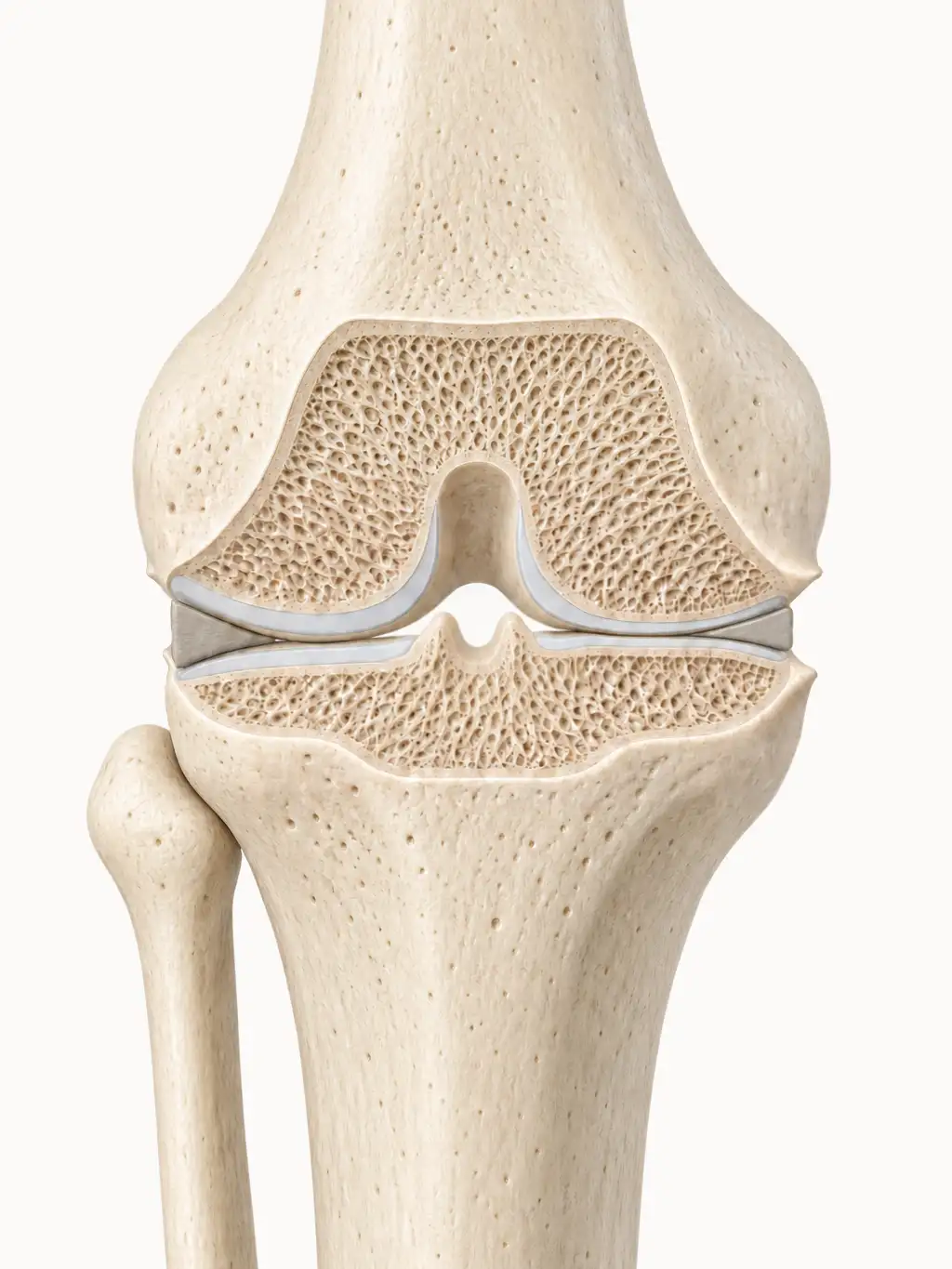
Grade 0Normal
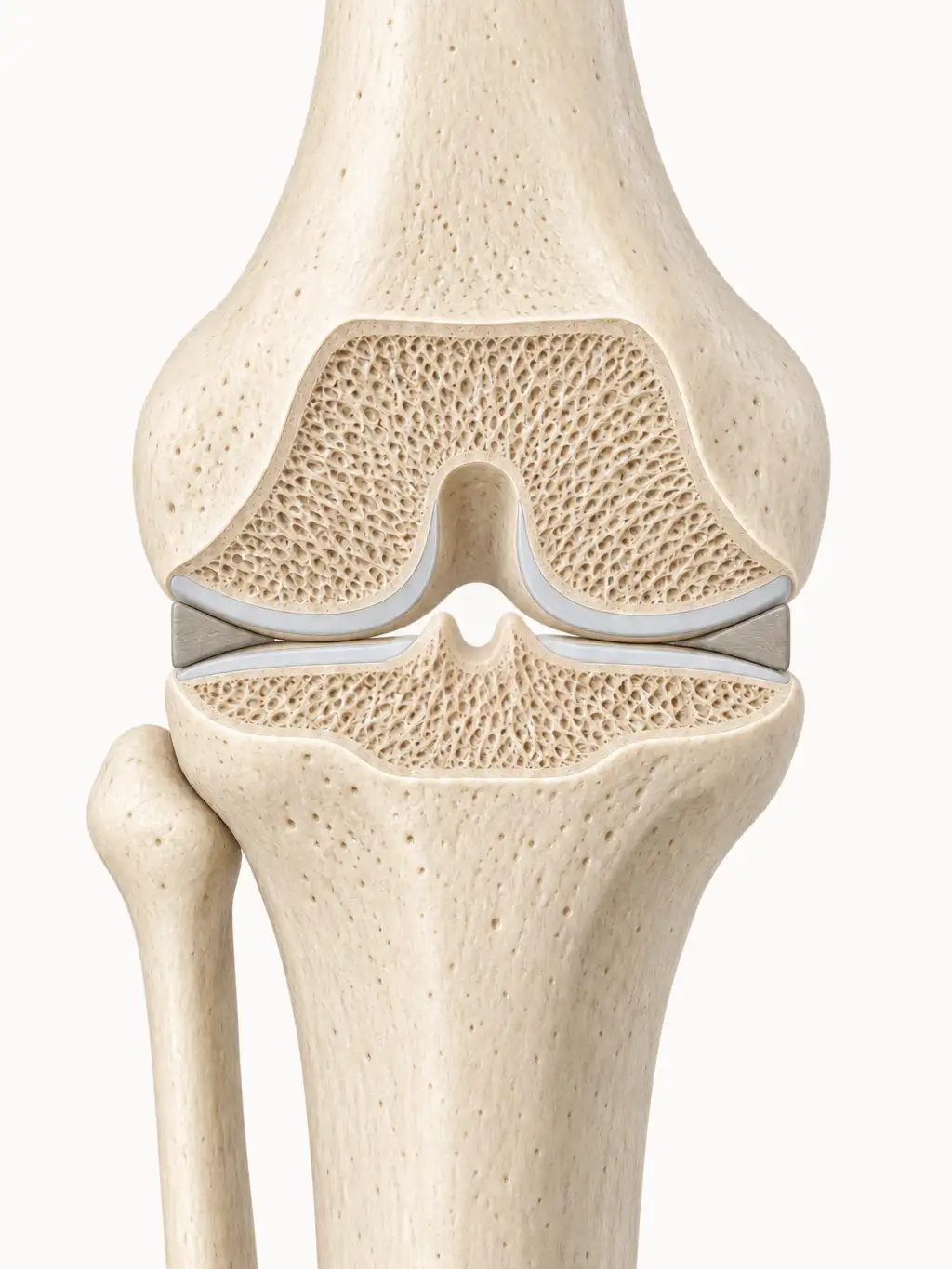
The joint space is even, with no bony outgrowths at the edges. Cartilage itself does not show on an X-ray: its thickness is judged by the width of the joint space.
Kosinskaya: has no stage 0
Circled: the inner compartment, where changes most often begin
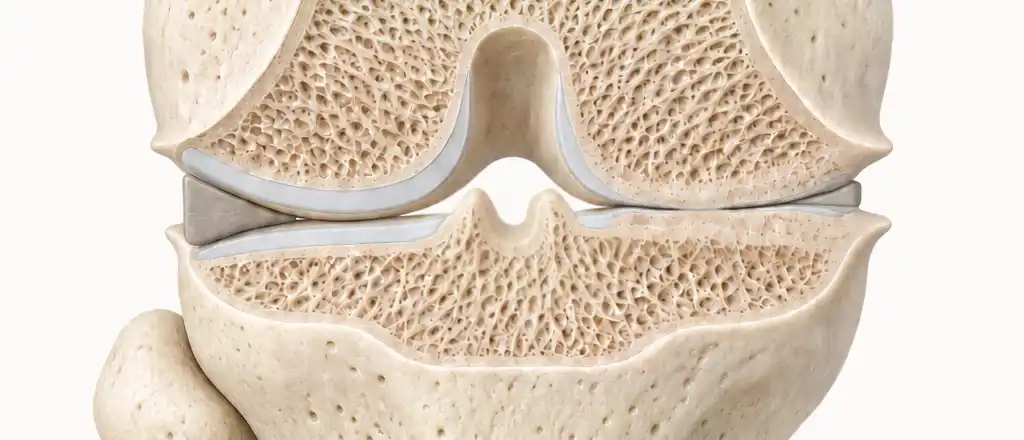
Front view of the knee with the joint ends cut through: smooth cartilage, equal joint space on both sides, smooth bone edges.
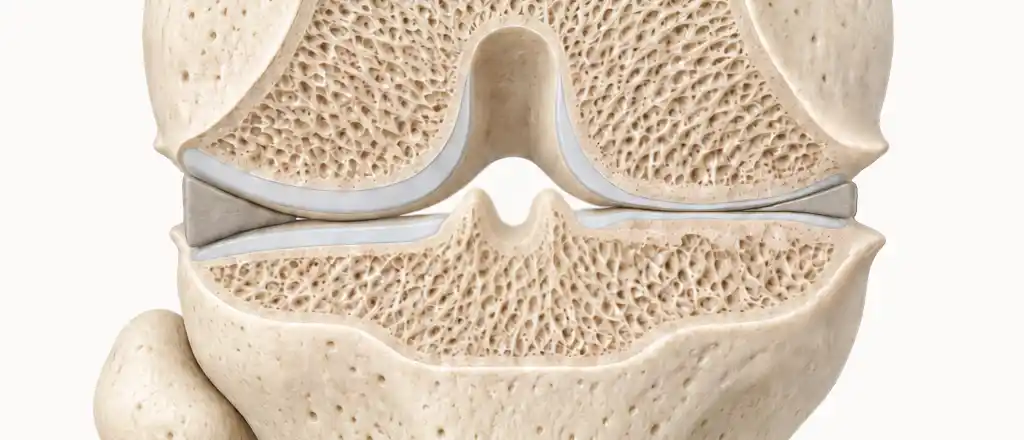
Grade IDoubtful changes
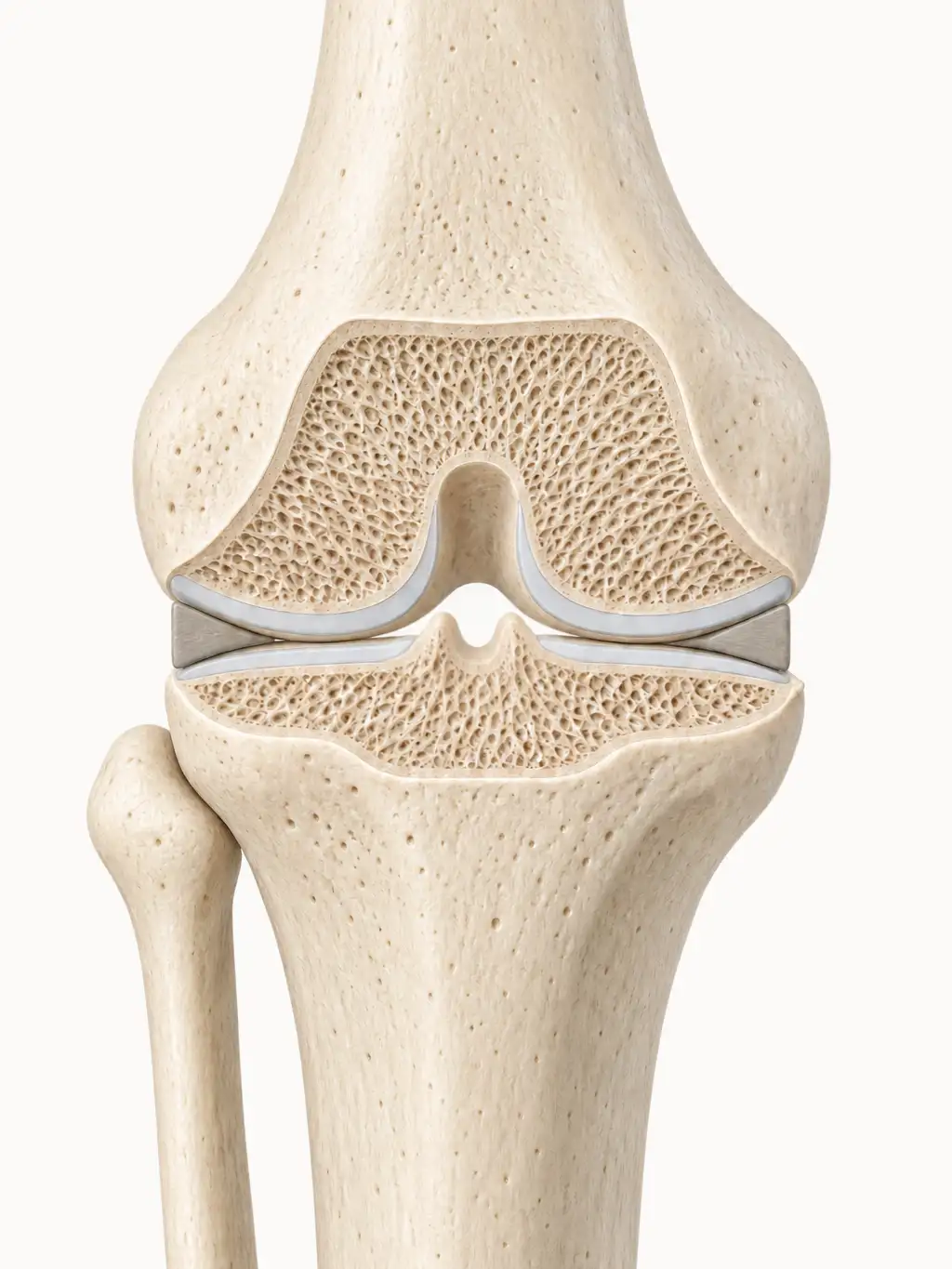
A tiny bony spur may be starting at the joint edge; the joint space is barely narrowed. Such an X-ray cannot confirm osteoarthritis.
Kosinskaya: ≈ stage I
A possible tiny spur at the bone edge
Knee diagram: a tiny bony spur is starting at the inner edge of the shin bone; the joint space is unchanged.
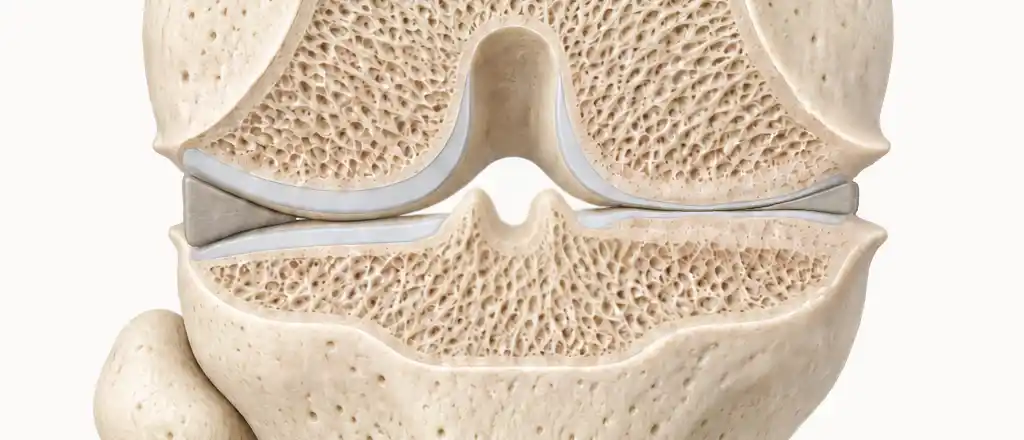
Grade IIMinimal changes
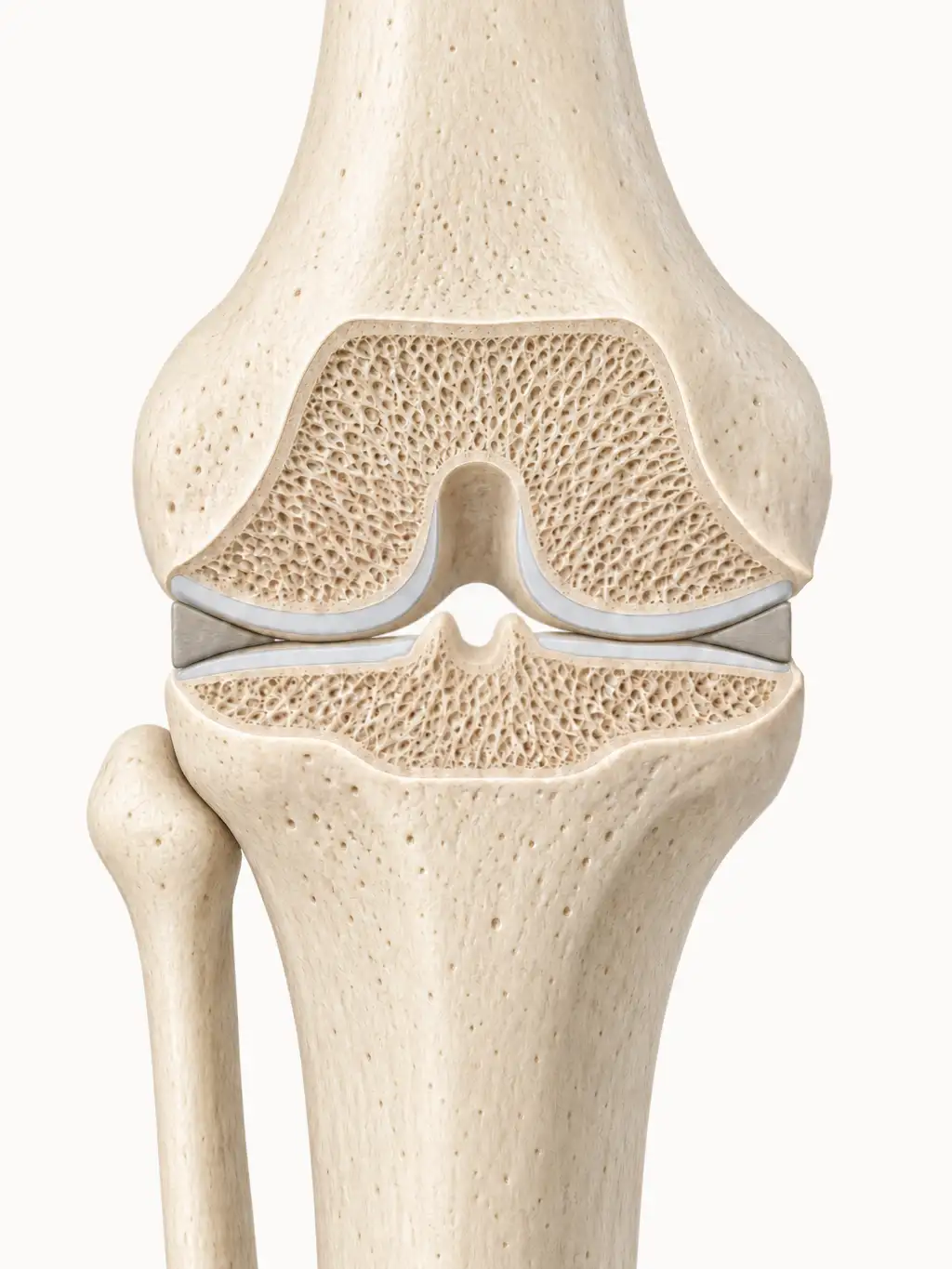
Single osteophytes — bony outgrowths — are clearly visible at the joint edges. The joint space may be slightly narrowed.
Kosinskaya: ≈ stage I
A definite osteophyte; the space may be slightly narrower
Knee diagram: a definite small osteophyte at the inner joint edge; in this drawing the inner joint space is slightly narrower, although at this grade it may not be narrowed at all.
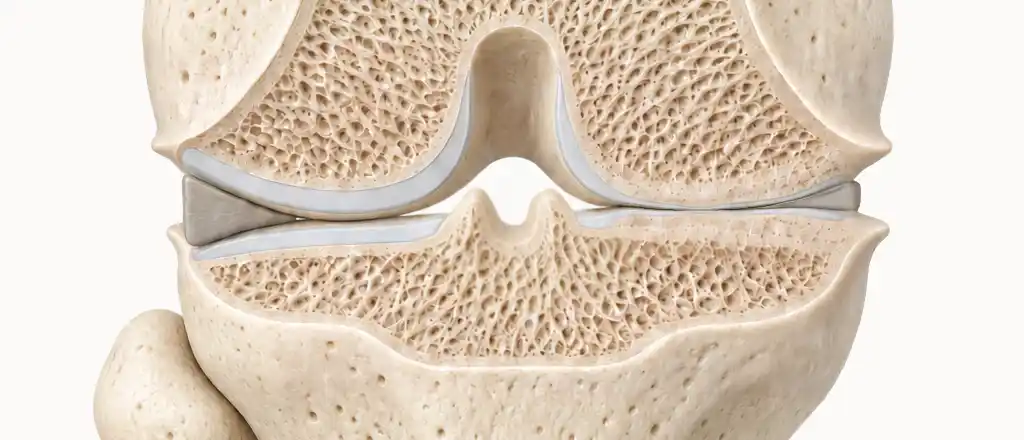
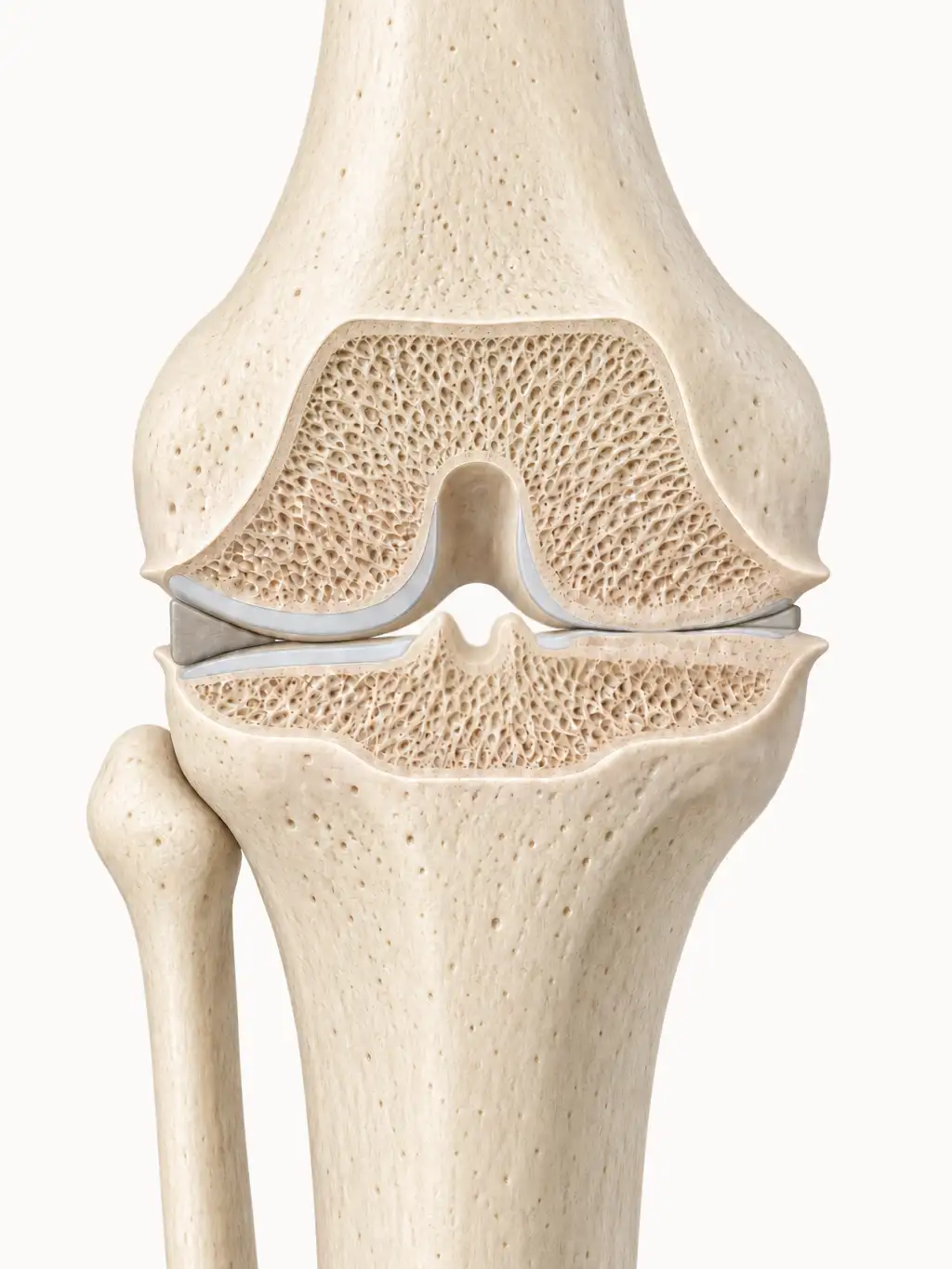
Grade IIIModerate changes
The joint space is clearly narrower, with several osteophytes. The bone beneath the cartilage becomes denser, and the joint surfaces begin to change shape.
Kosinskaya: ≈ stage II–III
A narrower space, larger bony outgrowths
Knee diagram: the inner compartment is clearly narrower, cartilage is thinner, larger osteophytes at the inner edge and a small new spur at the outer edge.
Grade IVSevere changes
The joint space is sharply narrowed; on the inner side almost no cartilage is left. Osteophytes are large, the bone beneath is dense and the shape of the bone ends has changed.
Kosinskaya: ≈ stage III
In the centre of the inner side cartilage is almost gone — bone nearly touches bone
Knee diagram: only thin strips of cartilage are left on the inner side and in the centre bone almost touches bone; the joint surface is flattened, with large osteophytes inside and small ones outside.
≈ means an approximate match: the scales rely on different signs, and the clinical guideline has no table for converting one into the other. How much a knee hurts does not always match the stage on the X-ray.[6]6Клинические рекомендации «Гонартроз» — Минздрав России, 2024To the list of sources →
Schematic illustration. The Kellgren–Lawrence scale grades an X-ray, where cartilage does not show; the drawing shows cartilage and bone conditionally. The kneecap is not shown; the joint ends are cut through.
2Decide
Indications for surgery
Russian guidelines on knee osteoarthritis list these conditions together as the indication for replacement:
- the X-ray shows Kosinskaya stage III (Kellgren–Lawrence grade III–IV);
- the pain is persistent;
- the joint limits movement and daily activities;
- treatment without surgery has not helped.[6]6Клинические рекомендации «Гонартроз» — Минздрав России, 2024To the list of sources →
There is no absolute age or weight limit. The decision rests on pain, how the joint works and your general health.[2]2Total Knee Replacement — AAOS OrthoInfo, 2024To the list of sources →
Surgery is postponed or ruled out in active infection and severe uncontrolled heart or lung disease. Poor circulation in the leg and some other conditions can also stand in the way. The surgeon, a physician and the anaesthetist assess them.[6]6Клинические рекомендации «Гонартроз» — Минздрав России, 2024To the list of sources →
The navigator is not a doctor: diagnosis and treatment stay with your physician.
Treatment without surgery
The first steps are exercise therapy, weight loss, painkillers, joint injections and braces. They are usually tried for at least several months before surgery is discussed.[6]6Клинические рекомендации «Гонартроз» — Минздрав России, 2024To the list of sources → How each option works is explained in Treatment without surgery on the basics page.
For the appointment: ticked statements
Statements are based on clinical guidelines and patient information[2, 6]2Total Knee Replacement — AAOS OrthoInfo, 20246Клинические рекомендации «Гонартроз» — Минздрав России, 2024To the list of sources →
What this means
Tick what applies to you
0 of 7 ticked
This is not a diagnosis — a guide for talking to your doctor
Questions about this chapter
When is it time for a knee replacement, and when is it too early?
Surgery is discussed at Kosinskaya stage III with persistent pain and limited movement. The condition is that exercise therapy, weight loss, medicines and injections have not helped over several months. Age and weight alone are not reasons to refuse surgery.
Should both knees be replaced at once?
If both joints are worn, they are replaced in one operation or in two, several months apart. A single operation saves time and one anaesthetic, but it is harder on the body: age and heart health matter. The surgeon and the anaesthetist decide together with you.
3Surgery
Total or partial
Total or partial knee replacement
How they differ
A partial replacement keeps more of your own knee and recovers faster, but it suits only arthritis in one half of the knee, and repeat operations are more common after it.
Also possible
Revision operation. Replacing an implant that is already in place. Higher infection risk: about 6.5% in the first year[4]4Periprosthetic joint infection after 1.66 million primary and revision arthroplasties (2015–2023) — PMC, 2025To the list of sources →
A partial implant that fails is usually replaced with a total one. Fewer patients die after partial replacement than after total replacement.[15, 20]15Adverse outcomes after total and unicompartmental knee replacement in 101 330 matched patients: a study of data from the National Joint Registry for England and Wales — The Lancet, 201420Patient relevant outcomes of unicompartmental versus total knee replacement: systematic review and meta-analysis — BMJ (PMC6383371), 2019To the list of sources → Results depend heavily on the surgeon’s experience with this operation. Ask how many they do a year.
What you will be given
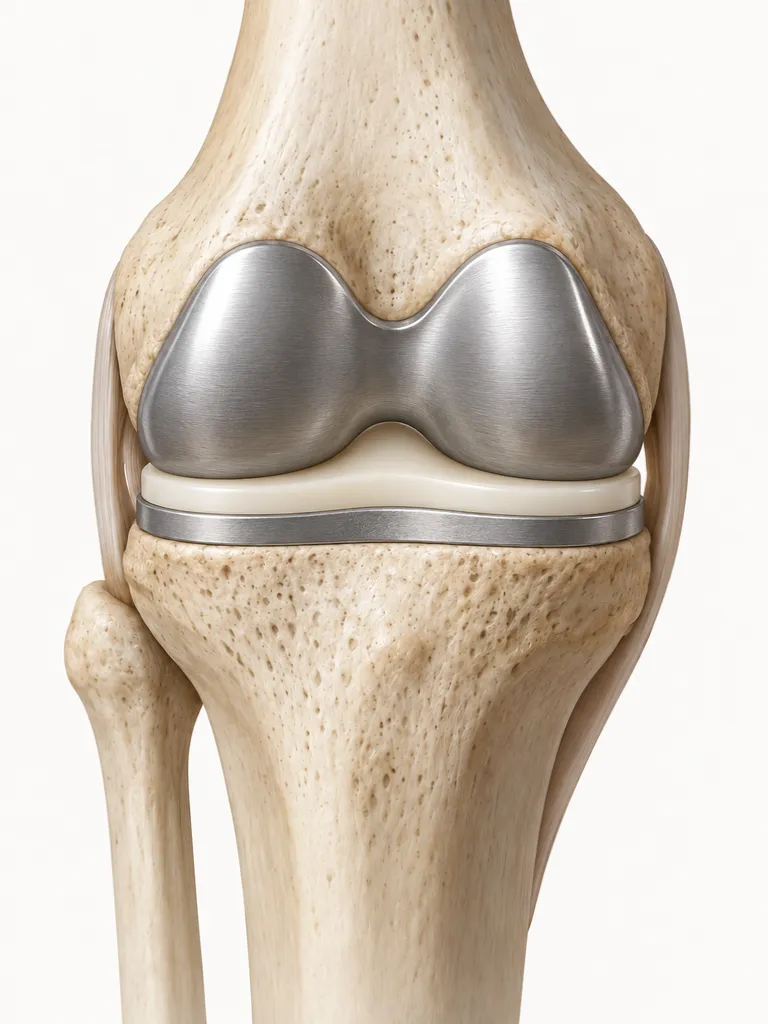
A knee implant has three or four parts that copy the shape of the joint.
- Femoral component: a metal cap on the end of the thigh bone. It is curved like the condyles and glides on the liner.
- Tibial component (tray): a metal plate with a stem on top of the shin bone.
- Liner: a plate of medical-grade polyethylene between the metal parts. It takes the friction and slowly wears.
- Patellar component: a polyethylene button on the back of the kneecap. It is not always used.[2]2Total Knee Replacement — AAOS OrthoInfo, 2024To the list of sources →
Implant design: four decisions the surgeon makes
2 min
No single design suits everyone. The choice depends on your ligaments, bone, deformity and the surgeon’s experience.
| Parameter | Options | What it means |
|---|---|---|
| Posterior cruciate ligament | CR — retaining; PS — substituting | Depends on the ligament’s condition; registries show slightly more revisions for PS; the surgeon decides |
| Bearing platform | Fixed or mobile bearing | No difference in revision rates has been shown |
| Fixation | Cemented (standard, over 90%), cementless (porous titanium), hybrid | Cementless is used more often in younger patients with good bone |
| Materials | Femoral component — cobalt-chrome; tray — titanium; liner — conventional, highly cross-linked (HXLPE) or vitamin-E polyethylene | Oxidised zirconium is used for nickel allergy; registries do not show it outperforming cobalt-chrome |
| Kneecap | Resurfaced or left alone | Practice varies between clinics and is decided individually |
Sources: AAOS OrthoInfo, 2024; AAOS OrthoInfo, 2024; NHS, 2024; The Lancet, 393(10172):655–663, 2019; Acta Orthopaedica, 2018; Australian Orthopaedic Association National Joint Replacement Registry (AOANJRR), 2024
Posterior cruciate ligament
This ligament stops the shin from sliding backwards. CR (cruciate-retaining) implants keep it. PS (posterior-stabilised) implants remove it, and a post on the liner takes over its job. PS is chosen when the ligament is damaged or the deformity is large. In the Dutch registry (133,841 operations), revisions over 8 years were slightly more common after PS: 6.1 % versus 4.2 %. The gap was largest in men under 60.[7]7Cruciate-retaining versus posterior-stabilised total knee arthroplasty: revision rates in the Dutch Arthroplasty Register (LROI) — Acta Orthopaedica, 2018To the list of sources → It is small and matters less than the state of your ligament and the surgeon’s experience with the model.
Bearing platform
In a fixed-bearing implant the liner is locked to the tray. In a mobile-bearing implant the liner can turn slightly, an attempt to reduce wear. Over more than twenty years of follow-up, neither design has proved superior.[21]21Knee Replacement Implants — AAOS OrthoInfo, 2024To the list of sources →
Kneecap
Some surgeons always resurface the kneecap, some only when it is badly worn, and some almost never. The difference in results is small. The decision is often made during surgery, once the surgeon sees the cartilage.[2]2Total Knee Replacement — AAOS OrthoInfo, 2024To the list of sources →
Materials and fixation
2 min
| Material | Where it is used | What is known |
|---|---|---|
| Cobalt-chrome alloy | Femoral component, sometimes the tray | Long-standing standard: the polished surface glides well on polyethylene[2]2Total Knee Replacement — AAOS OrthoInfo, 2024To the list of sources → |
| Titanium alloys | Tray, porous cementless surfaces | Bond well with bone; too soft for a gliding surface[2]2Total Knee Replacement — AAOS OrthoInfo, 2024To the list of sources → |
| Oxidised zirconium | Femoral component from some manufacturers | Ceramic surface on metal, an option for nickel allergy; no better than cobalt-chrome in the registry[22]22Annual Report — Hip, Knee & Shoulder Arthroplasty (oxidised zirconium vs CoCr femoral components) — Australian Orthopaedic Association National Joint Replacement Registry (AOANJRR), 2024To the list of sources → |
| Polyethylene (UHMWPE) | Liner, kneecap | The classic material; its wear is the main cause of late revisions |
| Highly cross-linked polyethylene (HXLPE) | Modern liners | Less wear in the lab and in hip registries; knee data are less clear-cut |
| Vitamin E polyethylene | Newest liners | Vitamin E protects the plastic from oxidation; no proven long-term benefit yet |
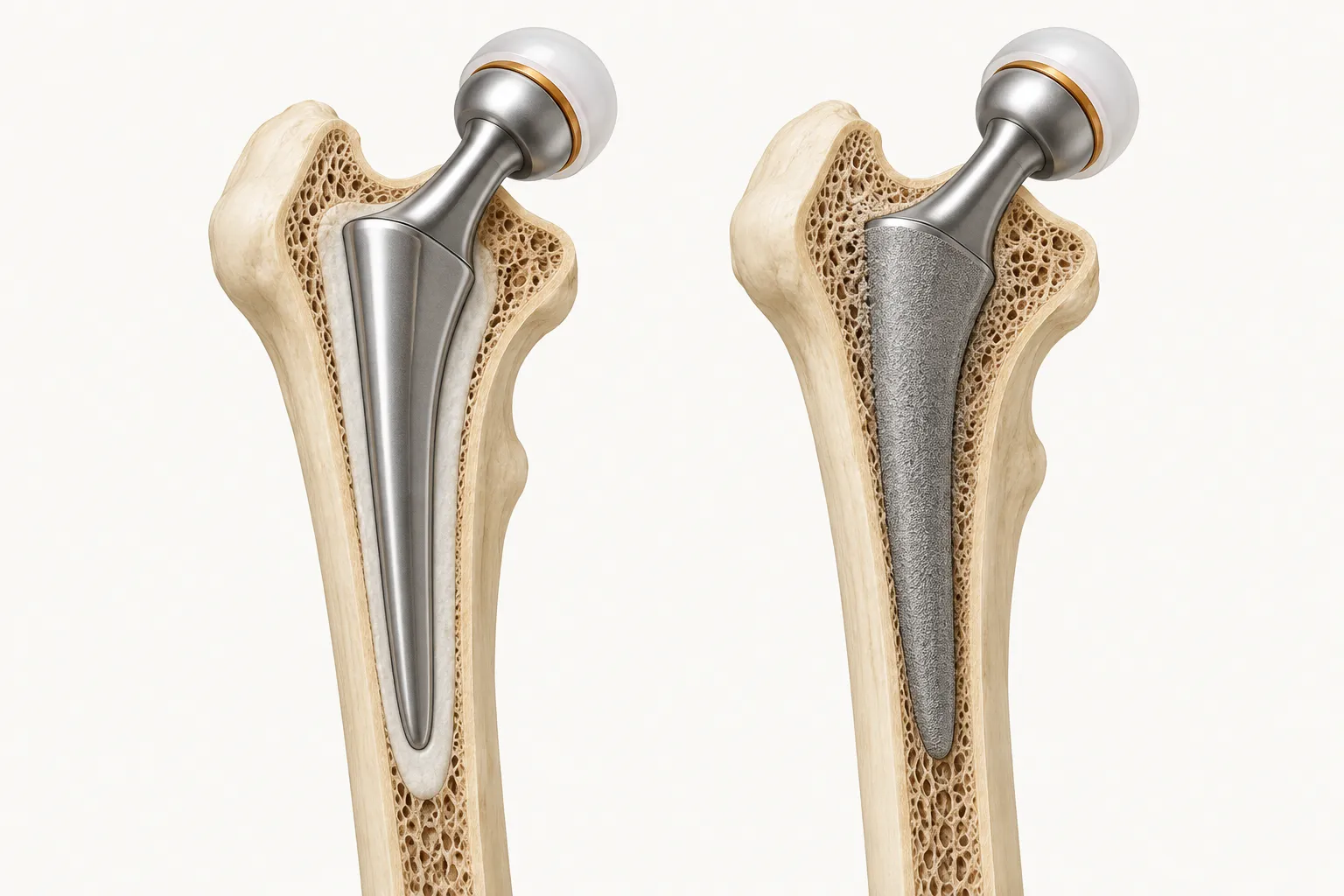
Cemented fixation attaches the parts to bone with fast-setting bone cement. It is the standard for most patients, especially older ones: the implant is stable at once, and results have been studied for decades. Cementless fixation uses porous metal that bone grows into over time. It is offered more often to younger patients with dense bone. A hybrid option cements one part only.[2, 5]2Total Knee Replacement — AAOS OrthoInfo, 20245Knee replacement — NHS, 2024To the list of sources →
If you have a metal allergy, especially to nickel, tell your surgeon in advance. Reactions to implants are rare, and nickel-free options exist.
Size, alignment and the robot
2 min
Implants come in several sizes in millimetre steps. Some models have separate sizes for men and women. The size is chosen from X-rays or CT and confirmed during surgery.
Alignment is still debated. Mechanical alignment places the implant strictly along the leg axis. Kinematic alignment follows your own, slightly curved axis. Neither approach has a convincing advantage yet.
Robotic systems help the surgeon make the planned bone cuts more precisely, with smaller deviations from the plan.[9]9Robotic-assisted total knee arthroplasty: precision versus patient-level outcomes — critical review — PMC, 2026To the list of sources → A benefit for the patient has not been proven. In the randomised RACER-Knee trial (339 patients), people rated their knee one year on the same as after conventional surgery. The robotic operation also cost more.[8]8Robotic-arm assisted versus conventional total knee replacement (RACER-Knee): a randomised controlled trial — The Lancet, 2026To the list of sources → The UK’s NICE allows these systems only if further data are collected.[10]10Robot-assisted surgery for soft tissue procedures and orthopaedic procedures (HTE22) — NICE, 2025To the list of sources → More on the robotic joint replacement page.
Preparation
Preparation starts several weeks before the operation and makes a real difference to recovery.[2]2Total Knee Replacement — AAOS OrthoInfo, 2024To the list of sources →
A few more points:
- Smoking. Stop at least a few weeks before: smoking slows wound healing.[5]5Knee replacement — NHS, 2024To the list of sources →
- Blood sugar. With diabetes, bring it to target beforehand: chronic conditions raise the risk of complications.[2]2Total Knee Replacement — AAOS OrthoInfo, 2024To the list of sources →
- X-rays. You need standing X-rays of both knees in two views.
- Paid surgery. Ask what the price includes: implant, hospital days, rehabilitation.
Training before surgery is called prehabilitation. It strengthens the thigh muscles and teaches the exercises you will need afterwards. People who have practised with crutches and exercises feel more confident in the first days.[2, 11]2Total Knee Replacement — AAOS OrthoInfo, 202411Total Knee Replacement Exercise Guide — AAOS OrthoInfo, 2024To the list of sources →
The day of surgery
In the morning the anaesthetist examines you. Spinal or general anaesthesia is used.[2, 5]2Total Knee Replacement — AAOS OrthoInfo, 20245Knee replacement — NHS, 2024To the list of sources → An antibiotic is given before the incision. Drugs that reduce blood loss are given during the operation.[6]6Клинические рекомендации «Гонартроз» — Минздрав России, 2024To the list of sources →
How knee replacement is performed
The four steps the surgeon takes once the anaesthetic is working.
Step 1. Access to the joint
An incision down the front of the knee; the kneecap is moved aside.
Step 2. Removing the worn surfaces
A thin layer of damaged cartilage and bone is removed from the femur and tibia using guides or the robotic plan.
Step 3. Trial and final components
Trial components are checked for ligament balance and range of motion, then the final femoral, tibial and liner components are fitted.
Step 4. Check and closure
The surgeon checks bending, straightening and stability, washes the joint and closes the wound in layers.
You then spend a few hours in the recovery room as the anaesthesia wears off. Then you return to the ward.[2]2Total Knee Replacement — AAOS OrthoInfo, 2024To the list of sources →
In hospital
- Day 0. The anaesthesia wears off within hours. Pain is controlled with tablets, injections and sometimes a nerve block or wound catheter. You start ankle pumps straight away to keep the blood moving. In many clinics you stand with a walker the same day.[2]2Total Knee Replacement — AAOS OrthoInfo, 2024To the list of sources →
- Days 1–2. Walking the ward and corridor with a walker or crutches, first exercises with a physiotherapist. Dressing changes and a check X-ray. Swelling and bruising are normal.[5]5Knee replacement — NHS, 2024To the list of sources →
- Days 2–5. Stairs, getting up unaided, full straightening and confident bending. Medicines against blood clots follow the doctor’s plan. When the first dose is given depends on the drug, the anaesthetic and bleeding risk. They usually continue for several weeks, with compression stockings.[5, 6, 16]5Knee replacement — NHS, 20246Клинические рекомендации «Гонартроз» — Минздрав России, 202416Apixaban for the prevention of venous thromboembolism after total hip or knee replacement (TA245) — NICE, 2012To the list of sources →
- Discharge. In the UK and US patients go home after 1–3 days, sometimes the same day.[5]5Knee replacement — NHS, 2024To the list of sources → Russian hospitals, especially state ones, usually keep patients 5–10 days. Some then move to a second-stage rehabilitation unit.[23]23Эндопротезирование сустава в России: сроки госпитализации и стоимость — russianhospitals.ru, 2026To the list of sources →
By discharge, aim to walk with support on floors and stairs and reach the toilet alone. You should also know your exercises and pain-relief plan.
Questions about this chapter
How long does the operation take, and what anaesthesia is used?
The operation takes 1–2 hours under spinal or general anaesthesia. Spinal anaesthesia is an injection in the lower back that numbs the legs, and light sedation helps you doze. General anaesthesia is used when spinal is not suitable or if you prefer it; the anaesthetist makes the final call.
4Recovery
Recovery plan
Timings depend on age, weight, muscle strength before surgery and the type of implant.
Optional. Enter how many full weeks have passed since the operation and we will mark the stage. The number stays in this tab only.
- Weeks 0–2You are here
- Walking with a frame or two crutches, exercises 2–3 times a day[11]11Total Knee Replacement Exercise Guide — AAOS OrthoInfo, 2024To the list of sources →
- Stitches or clips come out after about 10–14 days[5]5Knee replacement — NHS, 2024To the list of sources →
- Weeks 2–6You are here
- First one crutch, then a stick once you feel confident — usually within 2–6 weeks[5]5Knee replacement — NHS, 2024To the list of sources →
- Most everyday activities at home within 3–6 weeks[2]2Total Knee Replacement — AAOS OrthoInfo, 2024To the list of sources →
- Exercise bike from 4–6 weeks[11]11Total Knee Replacement Exercise Guide — AAOS OrthoInfo, 2024To the list of sources →
- Weeks 6–12You are here
- Follow-up appointment with the surgeon about 6 weeks after the operation[5]5Knee replacement — NHS, 2024To the list of sources →
- People try walking without an aid from about 6 weeks, if they feel ready[5]5Knee replacement — NHS, 2024To the list of sources →
- Driving no sooner than 6 weeks after a total and 3 weeks after a partial replacement, once the leg presses the pedal firmly[5, 12]5Knee replacement — NHS, 202412Return to driving after hip and knee arthroplasty: systematic review — PMC, 2020To the list of sources →
- Work usually after 6–12 weeks, depending on the kind of work[5]5Knee replacement — NHS, 2024To the list of sources →
- Months 3–6You are here
- Unlimited walking, swimming, cycling, golf, ballroom dancing, light hiking[2]2Total Knee Replacement — AAOS OrthoInfo, 2024To the list of sources →
- Months 6–12You are here
- Full recovery takes several months, sometimes longer; the knee starts to feel like your own[5, 13]5Knee replacement — NHS, 202413Knee Replacement — Cleveland Clinic, 2025To the list of sources →
- Running, jumping and other high-impact sports stay off the list for life[2]2Total Knee Replacement — AAOS OrthoInfo, 2024To the list of sources →
A guide based on the NHS and Russian clinical guidelines; your surgeon may change the timings[5, 6]5Knee replacement — NHS, 20246Клинические рекомендации «Гонартроз» — Минздрав России, 2024To the list of sources →
Driving and work in detail
1 min
In a systematic review, patients returned to driving after about 4 weeks on average, with a range of 1 to 8. That is an observation, not a permission. Your leg must be able to brake in time in an emergency. After a right knee replacement the wait is usually longer. Gearbox type made no difference. Check your insurance terms.[5, 12]5Knee replacement — NHS, 202412Return to driving after hip and knee arthroplasty: systematic review — PMC, 2020To the list of sources →
Working from home is sometimes possible earlier, and people return to physical jobs closer to 3 months. Swimming is fine once the wound has healed. At 6–12 weeks you can walk several kilometres and ride a bike gently.[5]5Knee replacement — NHS, 2024To the list of sources →
Exercises by phase
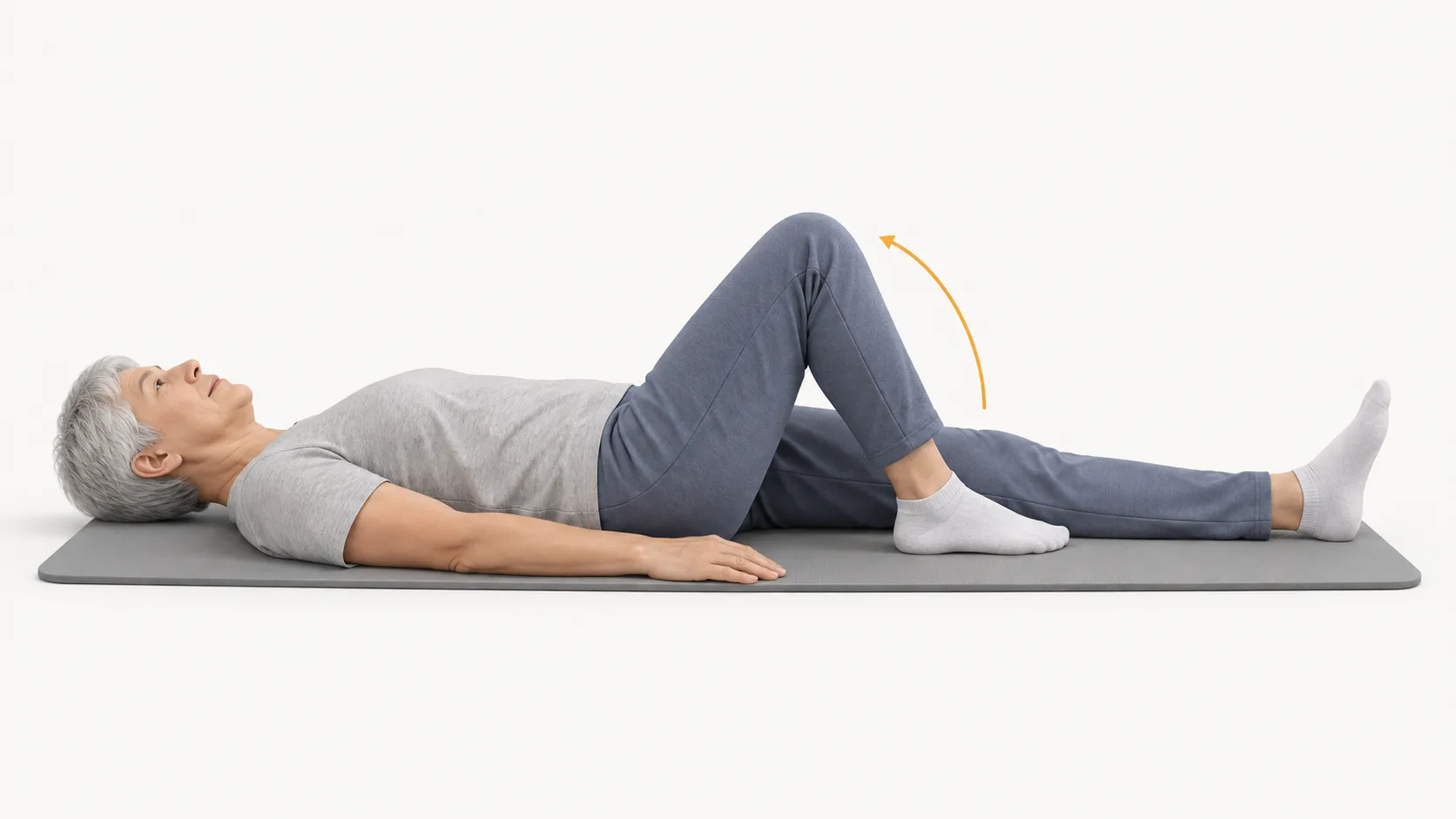
The programme follows the guide of the American Academy of Orthopaedic Surgeons (AAOS). Exercise for 20–30 minutes, ideally 2–3 times a day, and walk as well. Do not push through sharp pain, but mild discomfort while working on bending is unavoidable.[11]11Total Knee Replacement Exercise Guide — AAOS OrthoInfo, 2024To the list of sources →
Phase 1. First days, in bed and sitting
- Ankle pumps: pull the foot up and push it down. Do this for 2–3 minutes, 2–3 times an hour.
- Quad sets: press the back of the knee into the bed for 5–10 seconds.
- Heel slides: slide the heel towards the buttock as far as pain allows.
- Straight-leg raises: tighten the thigh muscle and lift the straight leg a few centimetres.
- Straightening: put a roll under the heel so the knee sags and straightens.[11]11Total Knee Replacement Exercise Guide — AAOS OrthoInfo, 2024To the list of sources →
Phase 2. Standing at a support, from the first days
- Standing knee bends, holding the back of a chair.
- Calf raises and half-squats at a support.
- Walking: start with 5–10 minutes several times a day and add time gradually.
- Stairs: go up with the good leg first and down with the operated leg first.[11]11Total Knee Replacement Exercise Guide — AAOS OrthoInfo, 2024To the list of sources →
Phase 3. Advanced, from about 4–6 weeks
- Exercise bike, seat raised: rock the pedals first, then make full turns.
- Resistance-band exercises for straightening and bending.
- Longer walks and a step platform.[11]11Total Knee Replacement Exercise Guide — AAOS OrthoInfo, 2024To the list of sources →
These are examples to show the idea. Your physiotherapist or rehabilitation doctor will tailor a routine to your implant and condition.
Complications and how often they happen
Every operation carries risk. You must be told about these complications before surgery.
| What can happen | How often | Source |
|---|---|---|
| Implant infectionfirst year after a primary operation, 1.66 million cases, USA | about 1.2% | [4]4Periprosthetic joint infection after 1.66 million primary and revision arthroplasties (2015–2023) — PMC, 2025To the list of sources → |
| Infection after a revision operationfirst year | about 6.5% | [4]4Periprosthetic joint infection after 1.66 million primary and revision arthroplasties (2015–2023) — PMC, 2025To the list of sources → |
| Venous thrombosis and embolismfirst 30 days with prophylaxis; after a revision about 1% | about 0.6% | [19]19Venous thromboembolism after total hip and knee arthroplasty: systematic review — PMC, 2020To the list of sources → |
| Not fully satisfied with the resultresidual pain, stiffness, unmet expectations | about 19% | [18]18Patient satisfaction after total knee arthroplasty: who is satisfied and who is not? — Clinical Orthopaedics and Related Research, 468(1):57–63, 2010To the list of sources → |
| Revision within 10 yearsregistry data; wear and loosening are the main cause of late revisions | about 3% | [3]3How long does a knee replacement last? A systematic review and meta-analysis of case series and national registry reports with more than 15 years of follow-up — The Lancet, 393(10172):655–663, 2019To the list of sources → |
Russian authors report an infection rate of about 3%; counting methods differ.[1]1Эпидемиология эндопротезирования тазобедренного и коленного суставов и перипротезной инфекции в Российской Федерации — Травматология и ортопедия России, 27(3):84–93, 2021To the list of sources →
Data verified
Smoking, diabetes with high blood sugar and obesity raise the risk of complications, including infection.[2, 5]2Total Knee Replacement — AAOS OrthoInfo, 20245Knee replacement — NHS, 2024To the list of sources → You can act on these factors in advance: see Preparation.
Other complications and what is done
2 min
- Infection. Treated with antibiotics. Deep infection needs another operation, sometimes with the implant removed for a while.
- Vein thrombosis and embolism. Rare with drug and compression prophylaxis.[5, 19]5Knee replacement — NHS, 202419Venous thromboembolism after total hip and knee arthroplasty: systematic review — PMC, 2020To the list of sources → The risk is higher with obesity, past clots and long immobility. Treated with anticoagulants, compression and early walking.
- Stiffness (arthrofibrosis). Affects a small share of patients, more often those who bent the knee poorly before surgery. Intensive physiotherapy helps; sometimes the knee is moved under anaesthesia.[2]2Total Knee Replacement — AAOS OrthoInfo, 2024To the list of sources →
- Instability. Rare. A brace and muscle strengthening help; severe instability needs a revision.[2]2Total Knee Replacement — AAOS OrthoInfo, 2024To the list of sources →
- Fracture near the implant. Rare; the risk is higher with osteoporosis and falls. The bone is fixed with plates or screws, or the implant is replaced.[5]5Knee replacement — NHS, 2024To the list of sources →
- Liner wear and loosening. The main cause of late revisions, after 10–20 years or more. The liner or other parts are replaced.[2]2Total Knee Replacement — AAOS OrthoInfo, 2024To the list of sources →
- Nerve and blood vessel injury. Very rare. Doctors observe and operate if needed.[2]2Total Knee Replacement — AAOS OrthoInfo, 2024To the list of sources →
- Dissatisfaction with the result. Doctors look for a cause: infection, instability or a problem outside the joint.
What to expect after a year
- Bending. Most people bend the knee to about 115°. That is enough for walking, stairs, getting into a car and rising from a chair. Deep squats and sitting on your heels are usually hard.[2]2Total Knee Replacement — AAOS OrthoInfo, 2024To the list of sources →
- Kneeling is possible, though many find it uncomfortable. It does not harm the implant.[2]2Total Knee Replacement — AAOS OrthoInfo, 2024To the list of sources →
- Clicking and tapping when you bend are normal: metal and plastic meet differently from cartilage. Most people stop noticing over time.[2]2Total Knee Replacement — AAOS OrthoInfo, 2024To the list of sources →
- Skin numbness beside the scar is common and usually permanent. Small skin nerves are cut during the incision.[2]2Total Knee Replacement — AAOS OrthoInfo, 2024To the list of sources →
- Airport metal detectors may go off. A certificate is not needed in most countries. Still, carrying your discharge summary is handy.[2]2Total Knee Replacement — AAOS OrthoInfo, 2024To the list of sources →
- Pain disappears or drops sharply for most people. Some remain not fully satisfied because of residual pain, stiffness or unmet expectations.[18]18Patient satisfaction after total knee arthroplasty: who is satisfied and who is not? — Clinical Orthopaedics and Related Research, 468(1):57–63, 2010To the list of sources → So talk with your surgeon before the operation about what you expect.
An implant does not give you the knee of a 30-year-old. For most people the operation greatly reduces pain and improves how the joint works. That is enough for an active life and low-impact sport, although some pain may remain.[2]2Total Knee Replacement — AAOS OrthoInfo, 2024To the list of sources →
Revision and implant lifespan in detail
2 min
National registries give the most reliable lifespan data: they record every operation and every implant replacement. A review in The Lancet pooled registries with more than 15 years of follow-up. Its 25-year figures are in the comparison of total and partial replacement.[3]3How long does a knee replacement last? A systematic review and meta-analysis of case series and national registry reports with more than 15 years of follow-up — The Lancet, 393(10172):655–663, 2019To the list of sources → More than 90 % of modern total knee implants last at least 15 years.[2]2Total Knee Replacement — AAOS OrthoInfo, 2024To the list of sources → Cleveland Clinic is more cautious and says “at least 10–15 years”.[13]13Knee Replacement — Cleveland Clinic, 2025To the list of sources →
If you have surgery after 65–70, most likely you will never need a second one. At 50 the chance of a revision in your lifetime is real, because the implant has many years of use ahead.[3]3How long does a knee replacement last? A systematic review and meta-analysis of case series and national registry reports with more than 15 years of follow-up — The Lancet, 393(10172):655–663, 2019To the list of sources → That is why surgeons often ask younger patients to try every option without surgery first.
A revision replaces all or part of the implant. The main reasons are infection, loosening, liner wear, instability, a fracture near the implant and persistent pain. Revisions are more complex: they need special implants with longer stems and extra blocks, and the infection risk is higher.[4, 2]4Periprosthetic joint infection after 1.66 million primary and revision arthroplasties (2015–2023) — PMC, 20252Total Knee Replacement — AAOS OrthoInfo, 2024To the list of sources →
To help your implant last, keep your weight under control and avoid running and jumping. Treat infections promptly and tell your dentist about the implant. Attend follow-up X-rays, usually at 3 and 12 months and then every few years.[2, 6]2Total Knee Replacement — AAOS OrthoInfo, 20246Клинические рекомендации «Гонартроз» — Минздрав России, 2024To the list of sources →
Questions about this chapter
Will it hurt, and for how long?
Pain after surgery is controlled with a mix of tablets, injections and nerve blocks. Sharp pain usually settles within 2–6 weeks; mild soreness and swelling with activity can last several months. If the pain gets worse, contact your doctor.
Can I have an MRI, and do I need antibiotics at the dentist?
Modern implants are MRI-compatible, but tell the staff in advance. Antibiotics before dental treatment depend on your risk factors: discuss this with your surgeon and dentist. Always tell doctors about your implant.
5Paying
Knee replacement is part of the state guarantee programme. Most primary operations are now done under the basic compulsory health insurance (OMS) programme. Complex and revision cases are funded by a VMP quota for high-tech medical care.[14]14Травматология и ортопедия по квоте (ВМП): как получить — gosmed.ru, 2025To the list of sources →
You will need a referral on form 057/u and a summary from your outpatient record.[17]17Приказ Минздрава России от 02.09.2025 № 519н: форма направления 057/у и порядок её ведения — Минздрав России, 2025To the list of sources → The route, documents and appeals are on the quota and OMS page.
Under a quota the implant comes from models the clinic has bought. You usually cannot pick a manufacturer. The wait depends on the region and clinic: a few weeks to a year or more.[14]14Травматология и ортопедия по квоте (ВМП): как получить — gosmed.ru, 2025To the list of sources →
The price of paid surgery covers the operation, the implant, hospital days and rehabilitation. Private clinics often charge for these separately. Reference prices are collected on the quota and international patients pages.
Questions about this chapter
Can I have the operation free of charge?
Yes, under OMS or a VMP quota: knee replacement is part of the state guarantee programme. You will need a referral on form 057/u and a summary from your outpatient record. How long you wait depends on the region and the clinic.