Patient dictionary: 60 terms
Osteoarthritis, liner, bearing couple, anterior approach, periprosthetic infection, VMP quota: short explanations of the words you will hear from your surgeon.
Author: Bagrat DzhavakhyanTreatment navigator, portal author
Not yet reviewed by a physicianSources: Russian Ministry of Health guidelines 2024, NHS, AAOS
Data verified
Contents
These are the words you will hear from an orthopaedic surgeon or read in a discharge summary. Terms are listed from A to Z. Abbreviations in brackets help you read clinic documents and articles.
A
Acetabular cup
The half-sphere part of a hip implant that sits in the socket of the pelvis. It is usually titanium, with a liner inside.
Arthrofibrosis
Too much scar tissue in the knee after surgery, so the joint does not bend well. It is treated with exercises, sometimes by moving the knee under anaesthesia.
Aseptic loosening and osteolysis
The implant loses its bond with the bone without infection, often as a reaction to wear particles. This is the main cause of late revision surgery.
Avascular necrosis of the femoral head (AVN)
Death of part of the bone because its blood supply is cut off, without infection. It is one cause of hip osteoarthritis in young and middle-aged people.
B
Bearing couple
The pair of materials used for the head and liner: metal on polyethylene, ceramic on polyethylene, or ceramic on ceramic. Metal on metal is now almost never used.
Blood clot prevention (VTE prophylaxis)
Measures against blood clots after surgery: blood-thinning medicine, compression stockings and foot exercises.
C
Ceramic
A material for the head and liner that wears very little. Rare downsides are squeaking and, very rarely, breakage. Ceramic has not been shown to reduce revisions.
Clinical guidelines (Russian Ministry of Health)
Official documents on diagnosing and treating a disease that Russian doctors follow. For osteoarthritis, the current ones are the 2024 guidelines on coxarthrosis and gonarthrosis[1, 2]1Клинические рекомендации «Коксартроз» (ID 870_1) — Минздрав России, 20242Клинические рекомендации «Гонартроз» — Минздрав России, 2024To the list of sources →.
Component alignment (mechanical, kinematic)
The principle the surgeon uses to position the implant. Mechanical alignment follows the axis of the leg; kinematic alignment stays closer to your own anatomy.
Compulsory health insurance (OMS)
Basic state-funded medical care under a health insurance policy. Primary joint replacement is part of the state guarantee programme: it is done under OMS or with a VMP quota.
Computer navigation (CAS)
A system that tracks surgical instruments with sensors and shows their position on a screen. No robot is involved.
Conservative treatment
Treatment without surgery: exercise therapy, weight loss, painkillers and injections into the joint. Russian guidelines recommend trying it before joint replacement is discussed[1]1Клинические рекомендации «Коксартроз» (ID 870_1) — Минздрав России, 2024To the list of sources →.
Coxarthrosis (hip osteoarthritis)
Osteoarthritis of the hip joint. Its stages and the indications for surgery are set out in the Russian clinical guidelines[1]1Клинические рекомендации «Коксартроз» (ID 870_1) — Минздрав России, 2024To the list of sources →.
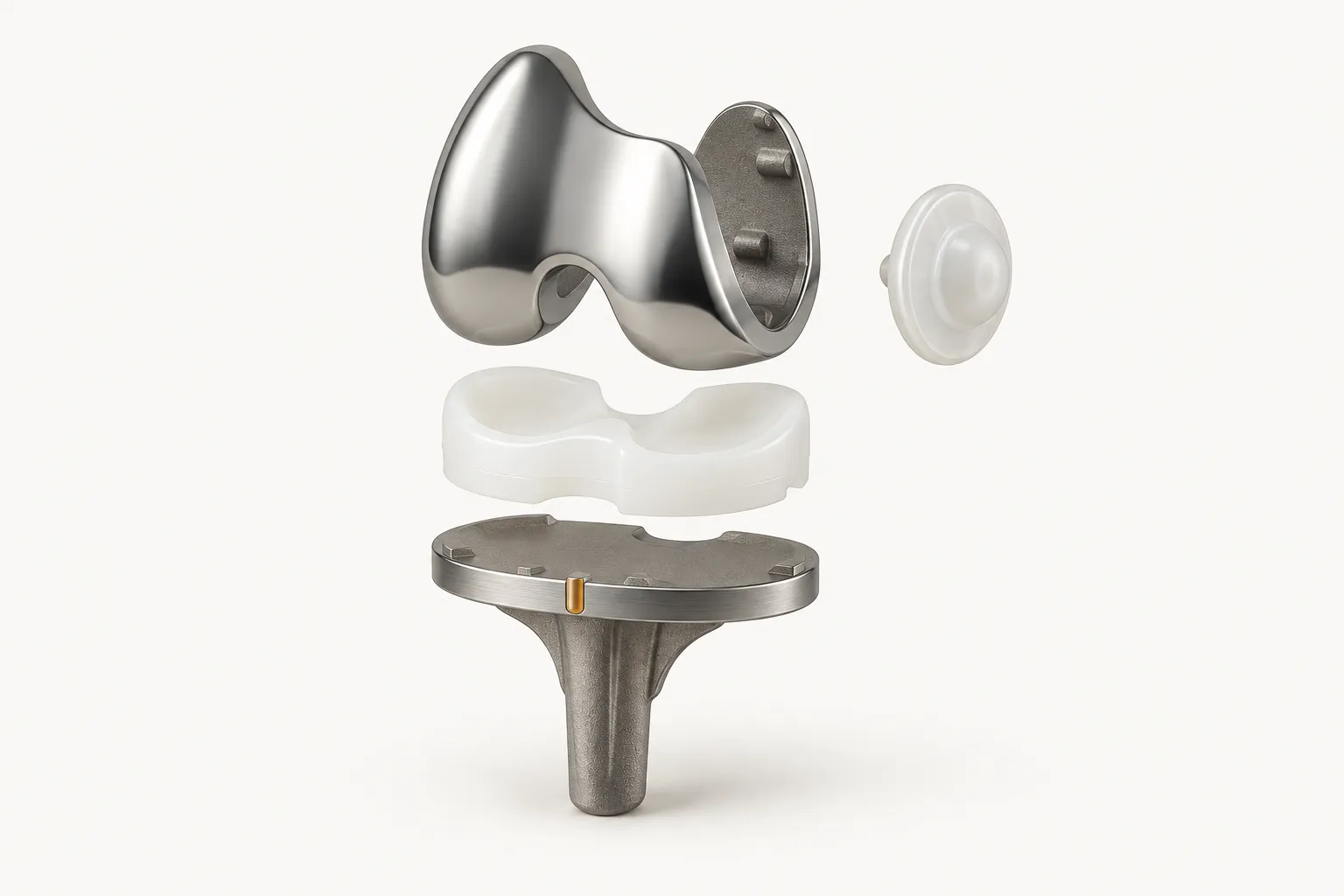
Cruciate-retaining and posterior-stabilised knees (CR, PS)
Two types of knee implant. A CR implant keeps your posterior cruciate ligament; a PS implant replaces it with a post on the liner.
CT-based planning
A 3D model of the joint built from a CT scan before surgery. Robotic systems such as Mako use it.
D
Deep vein thrombosis and pulmonary embolism (VTE, DVT)
A blood clot forms in a leg vein and can travel to the lungs. Prevention starts in hospital.
Direct anterior approach (DAA)
An approach to the hip between the muscles at the front of the thigh, without cutting them. A meta-analysis found faster early recovery and fewer dislocations[3]3Direct anterior versus posterior approach in total hip arthroplasty: systematic review and meta-analysis — Frontiers in Surgery, 2025To the list of sources →. The skin of the thigh may feel numb.
Dislocation
The head of the implant comes out of the cup. It happens most often in the first months after surgery. The risk depends on the approach, the head size and following the precautions.
Dual mobility
A cup design in which a polyethylene head itself turns inside a metal one. Registry data show it lowers the risk of dislocation, so it is used for patients at higher risk.
E
Early mobilisation
Part of an enhanced recovery programme (ERAS, fast-track). You get up and walk with support on the day of surgery or the next day.
F
Femoral component
The part of a knee implant that covers the lower end of the thigh bone. It is usually made of cobalt-chromium alloy.
Femoral head
A ceramic or metal ball fitted onto the stem of a hip implant. Head size affects how well the joint resists dislocation.
Femoral stem
The part of a hip implant that goes into the canal of the thigh bone. It can be cemented or cementless, standard or short.
Fixation (cemented, cementless, hybrid)
Cemented fixation holds the implant to the bone with a polymer. With cementless fixation, bone grows into the porous surface of the implant. Hybrid fixation combines both.
Follow-up X-ray
An X-ray that checks the position of the implant. Russian guidelines recommend one before discharge, at 3 and 12 months, then every 5 years[1]1Клинические рекомендации «Коксартроз» (ID 870_1) — Минздрав России, 2024To the list of sources →.
G
Gonarthrosis (knee osteoarthritis)
Osteoarthritis of the knee. It can affect one or all three compartments of the knee.
H
Haptic boundary
A virtual limit that the robot does not let the saw or burr cross. It protects bone and ligaments from unnecessary cutting.
Hemiarthroplasty
Replacement of the femoral head only, without the socket. It is done mainly for a broken hip (femoral neck fracture) in older people.
Hip dysplasia
A hip joint that did not develop fully: the socket covers the femoral head poorly. Dysplasia speeds up cartilage wear and hip osteoarthritis.
Hip precautions (the 90-degree rule)
Restrictions after hip replacement: do not bend the hip past 90°, cross your legs or turn your foot inwards. The set depends on the approach. They usually apply for up to 10–12 weeks[1]1Клинические рекомендации «Коксартроз» (ID 870_1) — Минздрав России, 2024To the list of sources →.
Hip resurfacing
The femoral head is kept and capped with a metal shell. It suits few patients, mainly young and active men with strong bone.
I
Implant survivorship
The share of implants that have not needed replacement after a given time. At 25 years, about 82 % of knee implants[4]4How long does a knee replacement last? A systematic review and meta-analysis of case series and national registry reports with more than 15 years of follow-up — The Lancet, 393(10172):655–663, 2019To the list of sources → and about 58 % of hip implants[5]5How long does a hip replacement last? A systematic review and meta-analysis of case series and national registry reports with more than 15 years of follow-up — The Lancet, 393(10172):647–654, 2019To the list of sources → are still in place. Ask your surgeon how long yours is expected to last.
J
Joint replacement (arthroplasty)
An operation that replaces a damaged joint with an artificial one. Russian documents call the artificial joint an endoprosthesis; this site calls it an implant.
K
Kellgren–Lawrence scale
An X-ray scale of osteoarthritis from grade 0 to IV. Surgery is usually discussed at grade III–IV if treatment without surgery has not helped[1]1Клинические рекомендации «Коксартроз» (ID 870_1) — Минздрав России, 2024To the list of sources →.
Kosinskaya scale
A Russian X-ray scale of osteoarthritis from stage I to III. Stage III with failed conservative treatment is the main indication for joint replacement[1]1Клинические рекомендации «Коксартроз» (ID 870_1) — Минздрав России, 2024To the list of sources →.
L
Liner (insert)
A replaceable polyethylene or ceramic part between the metal parts of the implant. The liner is the part that wears over time.
M
Medical board
A panel of doctors at a clinic or regional health authority. It confirms the indications for surgery and prepares the documents for a VMP quota.
Minimally invasive surgery (MIS, SuperPATH)
A technique with a smaller incision that damages less muscle. The result depends heavily on the surgeon’s experience.
O
Osteoarthritis (OA, arthrosis)
A long-term joint disease in which cartilage thins and breaks down. It causes pain, stiffness and limited movement.
P
Partial knee replacement (UKA)
Replacement of one compartment of the knee, usually the inner one. The incision is smaller and recovery is faster. Registry data show repeat surgery is needed more often than after total knee replacement[4]4How long does a knee replacement last? A systematic review and meta-analysis of case series and national registry reports with more than 15 years of follow-up — The Lancet, 393(10172):655–663, 2019To the list of sources →.
Patellofemoral arthroplasty
Replacement of the joint surface between the kneecap and the thigh bone. It is a rare operation for osteoarthritis limited to this part of the knee.
Patient-reported outcome measures (PROMs)
Questionnaires that measure pain and function before and after surgery. Patient questionnaires include WOMAC, the Oxford Hip Score and the Oxford Knee Score. The Harris Hip Score also includes the doctor’s assessment.
Patient-specific instrumentation (PSI)
Single-use cutting guides printed from your CT or MRI scan. They help the surgeon make the bone cuts according to plan.
Periprosthetic fracture
A break in the bone next to the implant, usually after a fall. The risk is higher with osteoporosis and in older people with a cementless stem.
Periprosthetic joint infection (PJI)
An infection around the implant. In the first year after a primary operation, it affects about 1.2–1.3 % of patients in the US[6]6Periprosthetic joint infection after 1.66 million primary and revision arthroplasties (2015–2023) — PMC, 2025To the list of sources →.
Polyethylene (UHMWPE, HXLPE)
Ultra-high-molecular-weight polyethylene, used to make the liner. HXLPE is a cross-linked version that wears less. Vitamin E versions protect it from oxidation, but a long-term benefit is not yet proven.
Posterior approach
The most common approach to the hip, through the muscles at the back. It gives the surgeon a good view but requires movement precautions after surgery.
R
Range of motion (ROM)
How far a joint bends and straightens, in degrees. After knee replacement, bending reaches about 115° on average, or less if scar tissue forms[7]7Total Knee Replacement — AAOS OrthoInfo, 2024To the list of sources →.
Rehabilitation stages
Russian guidelines describe three: in hospital, in a rehabilitation unit, and as an outpatient or at home[1]1Клинические рекомендации «Коксартроз» (ID 870_1) — Минздрав России, 2024To the list of sources →.
Revision surgery
A repeat operation to replace all or part of an implant. Reasons include infection, loosening, wear, dislocation or a fracture next to the implant.
Robotic-assisted joint replacement
An operation in which a robotic arm or handheld tool keeps the bone cut within the plan. The surgeon operates. Placement accuracy is proven; a benefit for pain and function is not[8, 9]8Robotic-arm assisted versus conventional total knee replacement (RACER-Knee): a randomised controlled trial — The Lancet, 20269Robot-assisted surgery for soft tissue procedures and orthopaedic procedures (HTE22) — NICE, 2025To the list of sources →.
S
Spinal anaesthesia
Pain relief by an injection in the lower back. The legs lose feeling while you stay awake or lightly sedated. It is a common choice for joint replacement.
Surgical approach
The route the surgeon takes to the joint through skin and muscle. The choice depends on your anatomy, the surgeon’s experience and the implant type.
T
Tibial tray
A metal platform on top of the shin bone. The polyethylene liner sits on it.
Total hip replacement (THA)
Replacement of both the femoral head and the socket. It is the main surgical treatment for stage III hip osteoarthritis[1]1Клинические рекомендации «Коксартроз» (ID 870_1) — Минздрав России, 2024To the list of sources →.
Total knee replacement (TKA)
Replacement of all joint surfaces of the knee, sometimes including the back of the kneecap[7]7Total Knee Replacement — AAOS OrthoInfo, 2024To the list of sources →.
Treatment navigator
A specialist who helps you understand the route, the documents and the choice of clinic. The navigator is not a doctor: diagnosis and treatment stay with your own doctor.
V
VMP quota (high-tech medical care)
The part of free state-funded care that includes joint replacement. It is arranged through a referral, a medical board and a VMP voucher, which people call a quota[10]10Травматология и ортопедия по квоте (ВМП): как получить — gosmed.ru, 2025To the list of sources →.
Voluntary health insurance (DMS)
Private health insurance from an employer or bought yourself. Not every plan covers joint replacement, so check the terms of your policy.
W
Walking aids (walker, crutches, cane)
A walker, crutches and a cane, used one after another. Your doctor or physiotherapist decides when to move on to the next one.
Cannot find a word? Ask your surgeon or write to us, and we will add it.
Sources (10)
Data verified
- Клинические рекомендации «Коксартроз» (ID 870_1)
- Клинические рекомендации «Гонартроз»
- Direct anterior versus posterior approach in total hip arthroplasty: systematic review and meta-analysis
- How long does a knee replacement last? A systematic review and meta-analysis of case series and national registry reports with more than 15 years of follow-up
- How long does a hip replacement last? A systematic review and meta-analysis of case series and national registry reports with more than 15 years of follow-up
- Periprosthetic joint infection after 1.66 million primary and revision arthroplasties (2015–2023)
- Total Knee Replacement
- Robotic-arm assisted versus conventional total knee replacement (RACER-Knee): a randomised controlled trial
- Robot-assisted surgery for soft tissue procedures and orthopaedic procedures (HTE22)
- Травматология и ортопедия по квоте (ВМП): как получить
This website provides general information and does not replace medical advice. Only your treating physician can diagnose and prescribe treatment in person.